Search icon CANCEL
Subscription
0
Cart icon
Your Cart (0 item)
Close icon
You have no products in your basket yet
Save more on your purchases! discount-offer-chevron-icon
Savings automatically calculated. No voucher code required.
Arrow left icon
Explore Products
Best Sellers
New Releases
Books
Videos
Audiobooks
Learning Hub
Newsletter Hub
Free Learning
Arrow right icon
timer SALE ENDS IN
0 Days
:
00 Hours
:
00 Minutes
:
00 Seconds
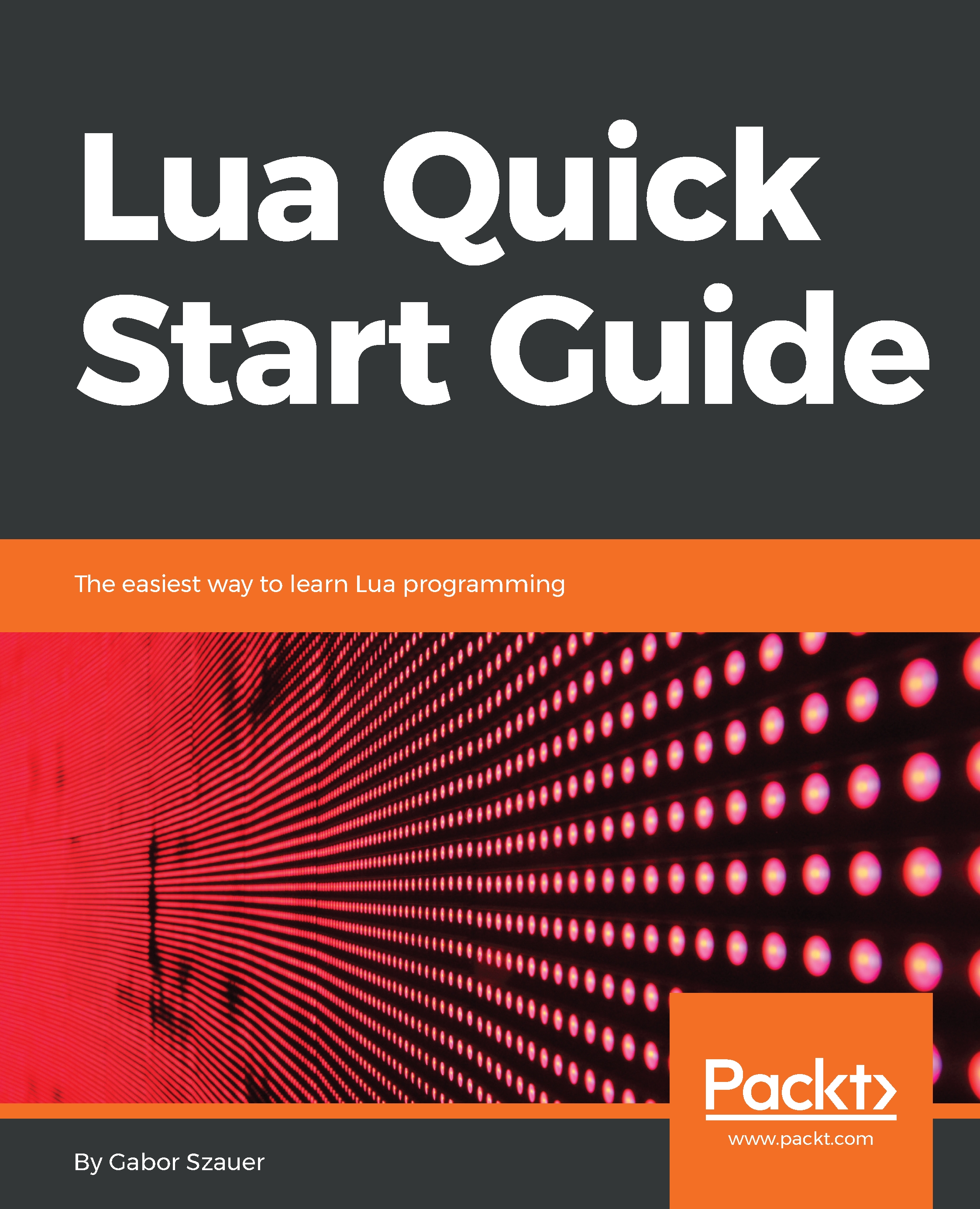
Lua Quick Start Guide

Lua Quick Start Guide

The easiest way to learn Lua programming

$32.99
By Gabor Szauer
Full star icon Full star icon Full star icon Half star icon Empty star icon
3.6 (7 Ratings)
Pages 202
Published in Jul 2018
Product Type Paperback
Edition 1st Edition
ISBN 9781789343229
Lua Quick Start Guide

Packt Subscriptions

See our plans and pricing
Modal Close icon
$12.99 billed monthly
Feature tick icon Unlimited access to Packt's library of 6,500+ practical books and videos
Feature tick icon Constantly refreshed with 50+ new titles a month
Feature tick icon Exclusive Early access to books as they're written
Feature tick icon Solve problems while you work with advanced search and reference features
Feature tick icon Offline reading on the mobile app
Feature tick icon Simple pricing, no contract
$129.99 billed annually
Feature tick icon Unlimited access to Packt's library of 6,500+ practical books and videos
Feature tick icon Constantly refreshed with 50+ new titles a month
Feature tick icon Exclusive Early access to books as they're written
Feature tick icon Solve problems while you work with advanced search and reference features
Feature tick icon Offline reading on the mobile app
Feature tick icon Choose a DRM-free eBook or Video every month to keep
Feature tick icon PLUS own as many other DRM-free eBooks or Videos as you like for just $5 each
Feature tick icon Exclusive print discounts
$179.99 billed in 18 months
Feature tick icon Unlimited access to Packt's library of 6,500+ practical books and videos
Feature tick icon Constantly refreshed with 50+ new titles a month
Feature tick icon Exclusive Early access to books as they're written
Feature tick icon Solve problems while you work with advanced search and reference features
Feature tick icon Offline reading on the mobile app
Feature tick icon Choose a DRM-free eBook or Video every month to keep
Feature tick icon PLUS own as many other DRM-free eBooks or Videos as you like for just $5 each
Feature tick icon Exclusive print discounts

What do you get with Print?

Product feature icon Instant access to your digital copy whilst your Print order is Shipped
Product feature icon Paperback book shipped to your preferred address
Product feature icon Redeem a companion digital copy on all Print orders
Product feature icon Access this title in our online reader with advanced features
Product feature icon DRM FREE - Read whenever, wherever and however you want
Table of content icon View table of contents Preview book icon Preview Book

Lua Quick Start Guide

Chapter 2. Working with Lua

In Chapter 1, Introduction to Lua, you learned how to set up Lua and Visual Studio Code. At the end of the chapter, we created a simple Hello World application. In this chapter, you will learn the basics of Lua programming. Topics such as variables, function data types, and loops are all going to be covered. By the end of this chapter, you should be familiar enough with Lua as a language to put together some simple programs.

Note

If this is your first time programming, the syntax of Lua can get overwhelming fast. Many resources can be found on the official Lua site at https://www.lua.org/. For a quick example of Lua, check out http://tylerneylon.com/a/learn-lua/.

By the end of this chapter, you will will have a solid understanding of the following:

  • Using variables
  • Data types
  • Working with functions
  • Operators
  • Code blocks
  • Variable scope
  • Code flow

Technical requirements


You will be required to have JavaScript programming language. Finally, to use the Git repository of this book, the user needs to install Git.

The code files of this chapter can be found on GitHub:https://github.com/PacktPublishing/Lua-Quick-Start-Guide/tree/master/Chapter02

Check out the following video to see the code in action:http://bit.ly/2LDVPd0

Variables


Variables are labels that provide a descriptive name for some data that a program can read or modify. You can literally think of a variable as a label.

For example, let's assume there are a number of jars containing different colored jam. How do you know what flavor a specific jar contains? Hopefully, there is a label on the jar that is descriptive of its content.

The labels on the jar can change over time. For example, a jar might contain strawberry jam, but after that's gone it might be filled with peach jam. When the contents of the jar changes, a different label can be used to describe what's in it. Variables work in a similar fashion.

Creating variables

To create a variable, you need to do two things:

  • Declare the variable
  • Assign a value (data) to the variable

As an example, let's make a variable, foo, and assign it the value bar. The code to do this would be:

foo = "bar"

That single line of code declares a variable and assigns a string value to the variable. If you break it into several...

Comments


In Lua, any time you see --, the rest of that line is considered a comment. Comments are there to help you read and understand code, but they are never executed. This example demonstrates how comments are used:

foo = "bar"
-- print (foo)
-- The above statement never prints
-- because it is commented out.

Basic types


In the last section, you were introduced to the concepts of a variable and a value. This section explores the concept of what a value is. Every value has a data type, which intuitively describes what kind of data the value holds. Lua supports eight basic value types:

  • nil: The absence of data. This type represents literal nothingness. If a certain piece of data is invalid or unknown, nil is usually the best way to represent that it is invalid or unknown.
  • Boolean: A value of true or false. A Boolean value is binary and can only ever be in one of two states, true or false.
  • number: A number can represent any real number: 0, -1, 5, or even decimals such as 3.14159265359.
  • string: A string is an array of characters. When declaring a string literal, it must be "enclosed within quotation marks."
  • function: A function is some code that is referred to by a name and can be executed any time.
  • table: A table contains information using key-value pairs. Tables will be covered in depth in Chapter 3...

String types


A string is an array of characters. Strings can represent words, sentences, or even whole books. In this section, we will cover how to perform the following string operations:

  • How to get the length of a string
  • How to concatenate two strings into a single new string
  • The coercion of other types into strings
  • String escape characters

Additionally, this section will cover how to read input from the console. You already know how to print information to the console; applications will become much more interactive once you can also read input from the console.

String literals

A string literal must be written between quotes. The following line of code demonstrates a string literal. This example does not do anything since the literal is a value that is never assigned to a variable:

"hello, world"

Without being assigned to a variable, this string can't be printed. String literals don't have to be assigned to a variable to be useful; they can be passed directly to a function such as print. The following...

Scope


Like many other programming languages, Lua implements the concept of scope for anything that can be named (like a variable). A scope defines where in the program a variable can be used. Scopes are limited to the chunks they appear in. A chunk is just a section of code. Some languages call chunks blocks because they are represented by blocks of code.

Every Lua file that is executed is a chunk. This chunk can contain other, smaller chunks. Think of it as a hierarchical relationship. Such a relationship could be visualized as follows:

You can create a local chunk in a file by using the do keyword. The chunk ends with the end keyword. The following bit of code demonstrates how to create a local chunk in a file:

-- main file chunk is anywhere in the file

do
  -- local chunk
end

do
  -- a different local chunk
end

As mentioned earlier, scope refers to visibility. A chunk can access any variables declared in its parent chunk, but none of the variables available in any child chunks. To demonstrate...

Functions


A function is essentially a named chunk of code. Unlike other chunks, the contents of a function are not automatically executed when the file is loaded. When a file is first loaded, functions are simply defined. Once a function has been defined, you can execute the function by calling it. Because a function is a named chunk, you can call a function as many times as you want. The same scope rules apply to functions as to do/end blocks.

Note

Read more about functions online at https://www.lua.org/pil/5.html.

Defining a function

A function declaration starts with the function keyword. After the function keyword, you provide thefunction name. The name of the function follows the same naming rules as the name of a variable.  

After the name of your function, you have to provide a list of parameters. Parameters are variable names enclosed in parentheses (). The list of parameters may be empty if a function needs no parameters, in which case only opening and closing parentheses are given—...

Operators


Operators such as addition +, string concatenation .., and even the assignment operator = have been used throughout this book. Let's take some time to cover in detail what operators are and how they work. Operators fall into one of the following categories:

  • Arithmetic operators do math.
  • Relational operators always return a Boolean value: true or false. Relational operators are used to compare the relationship between two things, for example, by checking whether one number is smaller than another number.
  • Logical operators express complex relations such as and/or. For example, logical operations can be used to check whether a number is less than seven AND greater than two.
  • Misc operators: All other operators, such as assignment, fall into this category.

Operators can be unary or binary. A unary operation works on only one operand. For example, the minus sign (-) is the unary negation operator. It returns the negative value of a number:

x = -7 -- negation operator applied to the constant...

Control structures


Control structures are used to make decisions in code; they control the path of code based on a Boolean value. Lua provides the if statement for this purpose. An if statement is followed by a Boolean condition, which in turn is followed by a then/end chunk. The chunk is only executed when the Boolean condition evaluates to true.

The most basic syntax of an if statement is as follows:

if

A logical control structure always starts with an if statement. As described previously, an if statement consists of the if keyword, a Boolean expression, and a then/end chunk. The then/end chunk is only executed when the Boolean condition evaluates to true. The following code sample demonstrates the basic use of an if statement:

print ("Enter your name")
name = io.read()

if #name <= 3 then
    print ("that's a short name, " .. name)
end

elseif

You might want to make a more complicated decision than a simple if statement allows. For example, you may want to do one thing if the length of a...

Loops


A chunk of code can be repeated multiple times by using a loop. Lua provides three types of loop, the while, repeat, and for loops. Each loop type will be covered in depth, but the rest of the book will mainly use the for loop.

while loops

Syntactically, a while loop starts with the while keyword, followed by a Boolean condition and a do/end chunk. The loop will keep executing the chunk of code so long as the Boolean condition evaluates to true:

x = 10 -- Initialize a "control" variable

while x > 0 do -- Boolean condition: x > 0
    print ("hello, world")

    x = x - 1 -- Decrement the "control" variable
end

Infinite loops

One of the dangers of loops is an infinite loop. You get into an infinite loop when the condition of the loop never evaluates to false. Because the condition keeps being true, the loop goes on forever. The following code snippet demonstrates a simple infinite loop:

while true do
    print ("forever")
end

A more real-life example of an infinite loop would look like...

Summary


This chapter covered a lot of topics, such as variables, data types, functions, operators, code blocks, scope, and code flow. All of these concepts are the basic building blocks of Lua. These concepts are very important to programming, so you may need to come back to this chapter.

In Chapter 3Tables and Objects, we will cover tables and objects. An alternate syntax of the for loop will be covered that can be used to easily iterate over tables or arrays.

Left arrow icon Right arrow icon
Download code icon Download Code

Key Benefits

The easiest way to learn Lua coding
Use the Lua standard libraries and debug Lua code
Embed Lua as a scripting language using the Lua C API

What You Will Learn

Who Is This Book For?

This book is for developers who want to get up and running with Lua. This book is ideal for programmers who want to learn to embed Lua in their own applications, as well as for beginner programmers who have never coded before.

Book Description

Lua is a small, powerful and extendable scripting/programming language that can be used for learning to program, and writing games and applications, or as an embedded scripting language. There are many popular commercial projects that allow you to modify or extend them through Lua scripting, and this book will get you ready for that. This book is the easiest way to learn Lua. It introduces you to the basics of Lua and helps you to understand the problems it solves. You will work with the basic language features, the libraries Lua provides, and powerful topics such as object-oriented programming. Every aspect of programming in Lua, variables, data types, functions, tables, arrays and objects, is covered in sufficient detail for you to get started. You will also find out about Lua's module system and how to interface with the operating system. After reading this book, you will be ready to use Lua as a programming language to write code that can interface with the operating system, automate tasks, make playable games, and much more. This book is a solid starting point for those who want to learn Lua in order to move onto other technologies such as Love2D or Roblox. A quick start guide is a focused, shorter title that provides a faster paced introduction to a technology. It is designed for people who don't need all the details at this point in their learning curve. This presentation has been streamlined to concentrate on the things you really need to know.

Category:
Languages:
Concepts:

Frequently bought together


Stars icon
Total $ 136.97
Lua Quick Start Guide
$32.99
Lua Game Development Cookbook
$54.99
Learning game AI programming with Lua
$48.99
Total $ 136.97 Stars icon

Table of Contents

(8 Chapters)
Introduction to Lua Chevron down icon Chevron up icon
Working with Lua Chevron down icon Chevron up icon
Tables and Objects Chevron down icon Chevron up icon
Lua Libraries Chevron down icon Chevron up icon
Debugging Lua Chevron down icon Chevron up icon
Embedding Lua Chevron down icon Chevron up icon
Lua Bridge Chevron down icon Chevron up icon
Next Steps Chevron down icon Chevron up icon

Customer reviews

Top Reviews
Rating distribution
Full star icon Full star icon Full star icon Half star icon Empty star icon
3.6
(7 Ratings)
5 star 42.9%
4 star 14.3%
3 star 14.3%
2 star 14.3%
1 star 14.3%
Filter icon Filter
Top Reviews

Filter reviews by


Shannon Nov 03, 2019
Full star icon Full star icon Full star icon Full star icon Full star icon
5
It covers the basic run through of the Lua code and that is just what I needed.
Amazon Verified review Amazon
Edward Beck Dec 12, 2021
Full star icon Full star icon Full star icon Full star icon Full star icon
5
Nice book easy to follow.
Amazon Verified review Amazon
Rufinity Feb 25, 2021
Full star icon Full star icon Full star icon Full star icon Full star icon
5
Still learning. Very informational
Amazon Verified review Amazon
William Aug 04, 2022
Full star icon Full star icon Full star icon Full star icon Empty star icon
4
The author does a reasonable job of showcasing the language to help someone get started in LUA quickly. I am using it to help teach a beginner how to program. The languag and style is down to earth and should be accessible to most people. NOTE- This book does not teach the art of programming, it is literally just a quick-start for LUA. If you want a book that teaches the art of programming using LUA you should look elsewhere.
Amazon Verified review Amazon
Objective Living Feb 07, 2020
Full star icon Full star icon Full star icon Empty star icon Empty star icon
3
This book is a pithy, bull in a china shop approach to teaching Lua. If you have a small project and just need the basics then this book will probably serve you well enough. If you really want to dig in, skip it entirely. 'Programming in Lua' by Roberto lerusalimschy (one of Lua's authors) is a much more thorough and well written guide to the language.A couple examples of things that frustrated me about this book are making statements like "scopes are limited to their chunks" and then showing examples where you declare variables as local. In actuality, most variables are global by default and thus have global scope unless you explicitly declare it as local. If you are coming from most other languages, you understand scope to be local by default and stating that scopes are limited to their chunks is, in my opinion, misleading or at least not well explained. I also found that he would frequently introduce something and then just not bother to explain it. For example, 'w = 7 and 1 -- value is 1'. Why? Why isn't it "false" instead of a number. In some ways Lua seems to go out of its way to not follow conventions held in common by many other languages. More explanation of the what and why would be really helpful.The book is less than 200 pages and is uses decently large font and lots of white space which makes everything very readable but does so by sacrificing detail. So, as I said, it's probably a decent intro for a small personal or school project but if you really want to dig in, I'd put that $30 into something more substantial. ~$18 seems like a decent price point for this book. I felt $30 is much too high for what it is.
Amazon Verified review Amazon
Get free access to Packt library with over 7500+ books and video courses for 7 days!
Start Free Trial

FAQs

What is the delivery time and cost of print book? Chevron down icon Chevron up icon

Shipping Details

USA:

'

Economy: Delivery to most addresses in the US within 10-15 business days

Premium: Trackable Delivery to most addresses in the US within 3-8 business days

UK:

Economy: Delivery to most addresses in the U.K. within 7-9 business days.
Shipments are not trackable

Premium: Trackable delivery to most addresses in the U.K. within 3-4 business days!
Add one extra business day for deliveries to Northern Ireland and Scottish Highlands and islands

EU:

Premium: Trackable delivery to most EU destinations within 4-9 business days.

Australia:

Economy: Can deliver to P. O. Boxes and private residences.
Trackable service with delivery to addresses in Australia only.
Delivery time ranges from 7-9 business days for VIC and 8-10 business days for Interstate metro
Delivery time is up to 15 business days for remote areas of WA, NT & QLD.

Premium: Delivery to addresses in Australia only
Trackable delivery to most P. O. Boxes and private residences in Australia within 4-5 days based on the distance to a destination following dispatch.

India:

Premium: Delivery to most Indian addresses within 5-6 business days

Rest of the World:

Premium: Countries in the American continent: Trackable delivery to most countries within 4-7 business days

Asia:

Premium: Delivery to most Asian addresses within 5-9 business days

Disclaimer:
All orders received before 5 PM U.K time would start printing from the next business day. So the estimated delivery times start from the next day as well. Orders received after 5 PM U.K time (in our internal systems) on a business day or anytime on the weekend will begin printing the second to next business day. For example, an order placed at 11 AM today will begin printing tomorrow, whereas an order placed at 9 PM tonight will begin printing the day after tomorrow.


Unfortunately, due to several restrictions, we are unable to ship to the following countries:

  1. Afghanistan
  2. American Samoa
  3. Belarus
  4. Brunei Darussalam
  5. Central African Republic
  6. The Democratic Republic of Congo
  7. Eritrea
  8. Guinea-bissau
  9. Iran
  10. Lebanon
  11. Libiya Arab Jamahriya
  12. Somalia
  13. Sudan
  14. Russian Federation
  15. Syrian Arab Republic
  16. Ukraine
  17. Venezuela
What is custom duty/charge? Chevron down icon Chevron up icon

Customs duty are charges levied on goods when they cross international borders. It is a tax that is imposed on imported goods. These duties are charged by special authorities and bodies created by local governments and are meant to protect local industries, economies, and businesses.

Do I have to pay customs charges for the print book order? Chevron down icon Chevron up icon

The orders shipped to the countries that are listed under EU27 will not bear custom charges. They are paid by Packt as part of the order.

List of EU27 countries: www.gov.uk/eu-eea:

A custom duty or localized taxes may be applicable on the shipment and would be charged by the recipient country outside of the EU27 which should be paid by the customer and these duties are not included in the shipping charges been charged on the order.

How do I know my custom duty charges? Chevron down icon Chevron up icon

The amount of duty payable varies greatly depending on the imported goods, the country of origin and several other factors like the total invoice amount or dimensions like weight, and other such criteria applicable in your country.

For example:

  • If you live in Mexico, and the declared value of your ordered items is over $ 50, for you to receive a package, you will have to pay additional import tax of 19% which will be $ 9.50 to the courier service.
  • Whereas if you live in Turkey, and the declared value of your ordered items is over € 22, for you to receive a package, you will have to pay additional import tax of 18% which will be € 3.96 to the courier service.
How can I cancel my order? Chevron down icon Chevron up icon

Cancellation Policy for Published Printed Books:

You can cancel any order within 1 hour of placing the order. Simply contact [email protected] with your order details or payment transaction id. If your order has already started the shipment process, we will do our best to stop it. However, if it is already on the way to you then when you receive it, you can contact us at [email protected] using the returns and refund process.

Please understand that Packt Publishing cannot provide refunds or cancel any order except for the cases described in our Return Policy (i.e. Packt Publishing agrees to replace your printed book because it arrives damaged or material defect in book), Packt Publishing will not accept returns.

What is your returns and refunds policy? Chevron down icon Chevron up icon

Return Policy:

We want you to be happy with your purchase from Packtpub.com. We will not hassle you with returning print books to us. If the print book you receive from us is incorrect, damaged, doesn't work or is unacceptably late, please contact Customer Relations Team on [email protected] with the order number and issue details as explained below:

  1. If you ordered (eBook, Video or Print Book) incorrectly or accidentally, please contact Customer Relations Team on [email protected] within one hour of placing the order and we will replace/refund you the item cost.
  2. Sadly, if your eBook or Video file is faulty or a fault occurs during the eBook or Video being made available to you, i.e. during download then you should contact Customer Relations Team within 14 days of purchase on [email protected] who will be able to resolve this issue for you.
  3. You will have a choice of replacement or refund of the problem items.(damaged, defective or incorrect)
  4. Once Customer Care Team confirms that you will be refunded, you should receive the refund within 10 to 12 working days.
  5. If you are only requesting a refund of one book from a multiple order, then we will refund you the appropriate single item.
  6. Where the items were shipped under a free shipping offer, there will be no shipping costs to refund.

On the off chance your printed book arrives damaged, with book material defect, contact our Customer Relation Team on [email protected] within 14 days of receipt of the book with appropriate evidence of damage and we will work with you to secure a replacement copy, if necessary. Please note that each printed book you order from us is individually made by Packt's professional book-printing partner which is on a print-on-demand basis.

What tax is charged? Chevron down icon Chevron up icon

Currently, no tax is charged on the purchase of any print book (subject to change based on the laws and regulations). A localized VAT fee is charged only to our European and UK customers on eBooks, Video and subscriptions that they buy. GST is charged to Indian customers for eBooks and video purchases.

What payment methods can I use? Chevron down icon Chevron up icon

You can pay with the following card types:

  1. Visa Debit
  2. Visa Credit
  3. MasterCard
  4. PayPal
What is the delivery time and cost of print books? Chevron down icon Chevron up icon

Shipping Details

USA:

'

Economy: Delivery to most addresses in the US within 10-15 business days

Premium: Trackable Delivery to most addresses in the US within 3-8 business days

UK:

Economy: Delivery to most addresses in the U.K. within 7-9 business days.
Shipments are not trackable

Premium: Trackable delivery to most addresses in the U.K. within 3-4 business days!
Add one extra business day for deliveries to Northern Ireland and Scottish Highlands and islands

EU:

Premium: Trackable delivery to most EU destinations within 4-9 business days.

Australia:

Economy: Can deliver to P. O. Boxes and private residences.
Trackable service with delivery to addresses in Australia only.
Delivery time ranges from 7-9 business days for VIC and 8-10 business days for Interstate metro
Delivery time is up to 15 business days for remote areas of WA, NT & QLD.

Premium: Delivery to addresses in Australia only
Trackable delivery to most P. O. Boxes and private residences in Australia within 4-5 days based on the distance to a destination following dispatch.

India:

Premium: Delivery to most Indian addresses within 5-6 business days

Rest of the World:

Premium: Countries in the American continent: Trackable delivery to most countries within 4-7 business days

Asia:

Premium: Delivery to most Asian addresses within 5-9 business days

Disclaimer:
All orders received before 5 PM U.K time would start printing from the next business day. So the estimated delivery times start from the next day as well. Orders received after 5 PM U.K time (in our internal systems) on a business day or anytime on the weekend will begin printing the second to next business day. For example, an order placed at 11 AM today will begin printing tomorrow, whereas an order placed at 9 PM tonight will begin printing the day after tomorrow.


Unfortunately, due to several restrictions, we are unable to ship to the following countries:

  1. Afghanistan
  2. American Samoa
  3. Belarus
  4. Brunei Darussalam
  5. Central African Republic
  6. The Democratic Republic of Congo
  7. Eritrea
  8. Guinea-bissau
  9. Iran
  10. Lebanon
  11. Libiya Arab Jamahriya
  12. Somalia
  13. Sudan
  14. Russian Federation
  15. Syrian Arab Republic
  16. Ukraine
  17. Venezuela
Modal Close icon

Loading shipping options...

Unable to load shipping costs. Please try again later.

Estimated Shipping Cost

Deliver to -
Modal Close icon
Modal Close icon