




















































Search icon CANCEL
Subscription
0
Cart icon
Your Cart (0 item)
Close icon
You have no products in your basket yet
Save more on your purchases! discount-offer-chevron-icon
Savings automatically calculated. No voucher code required.
Arrow left icon
Explore Products
Best Sellers
New Releases
Books
Videos
Audiobooks
Learning Hub
Newsletter Hub
Free Learning
Arrow right icon
timer SALE ENDS IN
0 Days
:
00 Hours
:
00 Minutes
:
00 Seconds
Arrow up icon
GO TO TOP
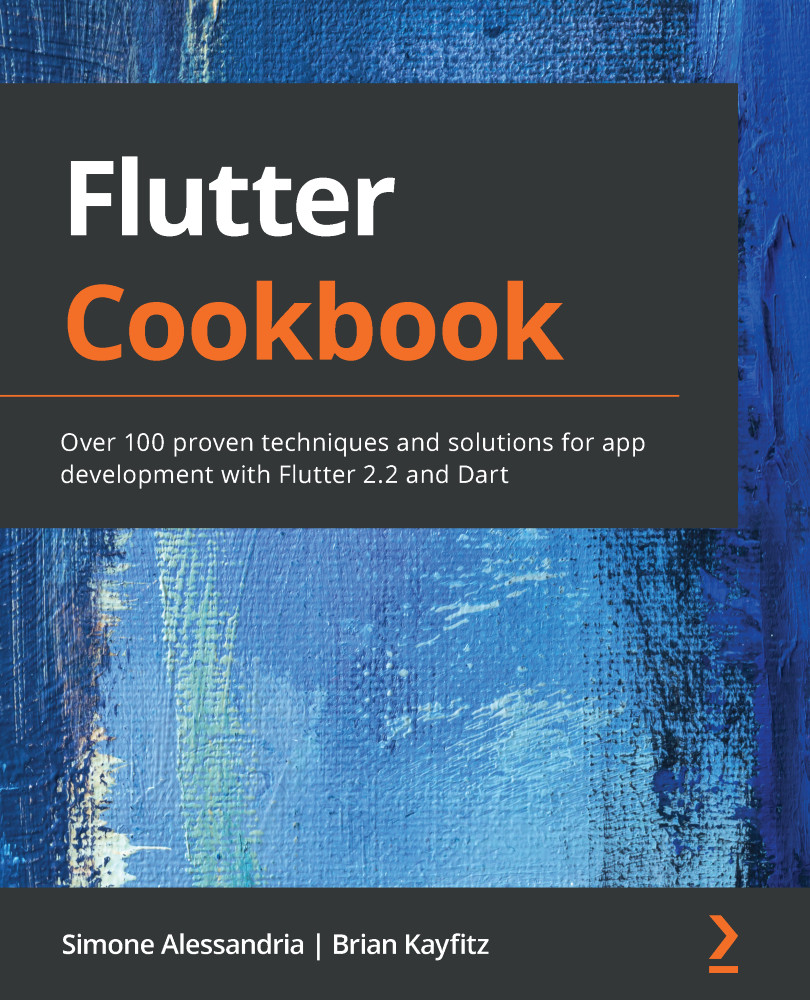
Flutter Cookbook

You're reading from   Flutter Cookbook Over 100 proven techniques and solutions for app development with Flutter 2.2 and Dart

Arrow left icon
Product type Paperback
Published in Jun 2021
Publisher Packt
ISBN-13 9781838823382
Length 646 pages
Edition 1st Edition
Languages
Tools
Arrow right icon
Authors (2):
Arrow left icon
Simone Alessandria Simone Alessandria
Author Profile Icon Simone Alessandria
Simone Alessandria
Brian Kayfitz Brian Kayfitz
Author Profile Icon Brian Kayfitz
Brian Kayfitz
Arrow right icon
View More author details
Toc

Table of Contents (17) Chapters Close

Preface 1. Getting Started with Flutter 2. Dart: A Language You Already Know FREE CHAPTER 3. Introduction to Widgets 4. Mastering Layout and Taming the Widget Tree 5. Adding Interactivity and Navigation to Your App 6. Basic State Management 7. The Future is Now: Introduction to Asynchronous Programming 8. Data Persistence and Communicating with the Internet 9. Advanced State Management with Streams 10. Using Flutter Packages 11. Adding Animations to Your App 12. Using Firebase 13. Machine Learning with Firebase ML Kit 14. Distributing Your Mobile App 15. Flutter Web and Desktop 16. About Packt

Designing an HTTP client and getting data

Most mobile apps rely on data that comes from an external source. Think of apps for reading books, watching movies, sharing pictures with your friends, reading the news, or writing emails: all these apps use data taken from an external source. When an app consumes external data, usually, there is a backend service that provides that data for the app: a web service or web API.

What happens is that your app (frontend or client) connects to a web service over HTTP and requests some data. The backend service then responds by sending the data to the app, usually in .json or .xml format.

For this app, we will create an app that reads and writes data from a web service. As creating a web API is well beyond the scope of this book, we will use a mock service, called MockLab, that will simulate the behavior of a real web service, but will be extremely easy to set up and use. In a later chapter, you will also see another way of creating a real-world backend...

lock icon The rest of the chapter is locked
Register for a free Packt account to unlock a world of extra content!
A free Packt account unlocks extra newsletters, articles, discounted offers, and much more. Start advancing your knowledge today.
Unlock this book and the full library FREE for 7 days
Get unlimited access to 7000+ expert-authored eBooks and videos courses covering every tech area you can think of
Renews at $15.99/month. Cancel anytime
Visually different images
Modal Close icon
Modal Close icon