Search icon CANCEL
Subscription
0
Cart icon
Your Cart (0 item)
Close icon
You have no products in your basket yet
Arrow left icon
Explore Products
Best Sellers
New Releases
Books
Videos
Audiobooks
Learning Hub
Newsletter Hub
Free Learning
Arrow right icon
timer SALE ENDS IN
0 Days
:
00 Hours
:
00 Minutes
:
00 Seconds
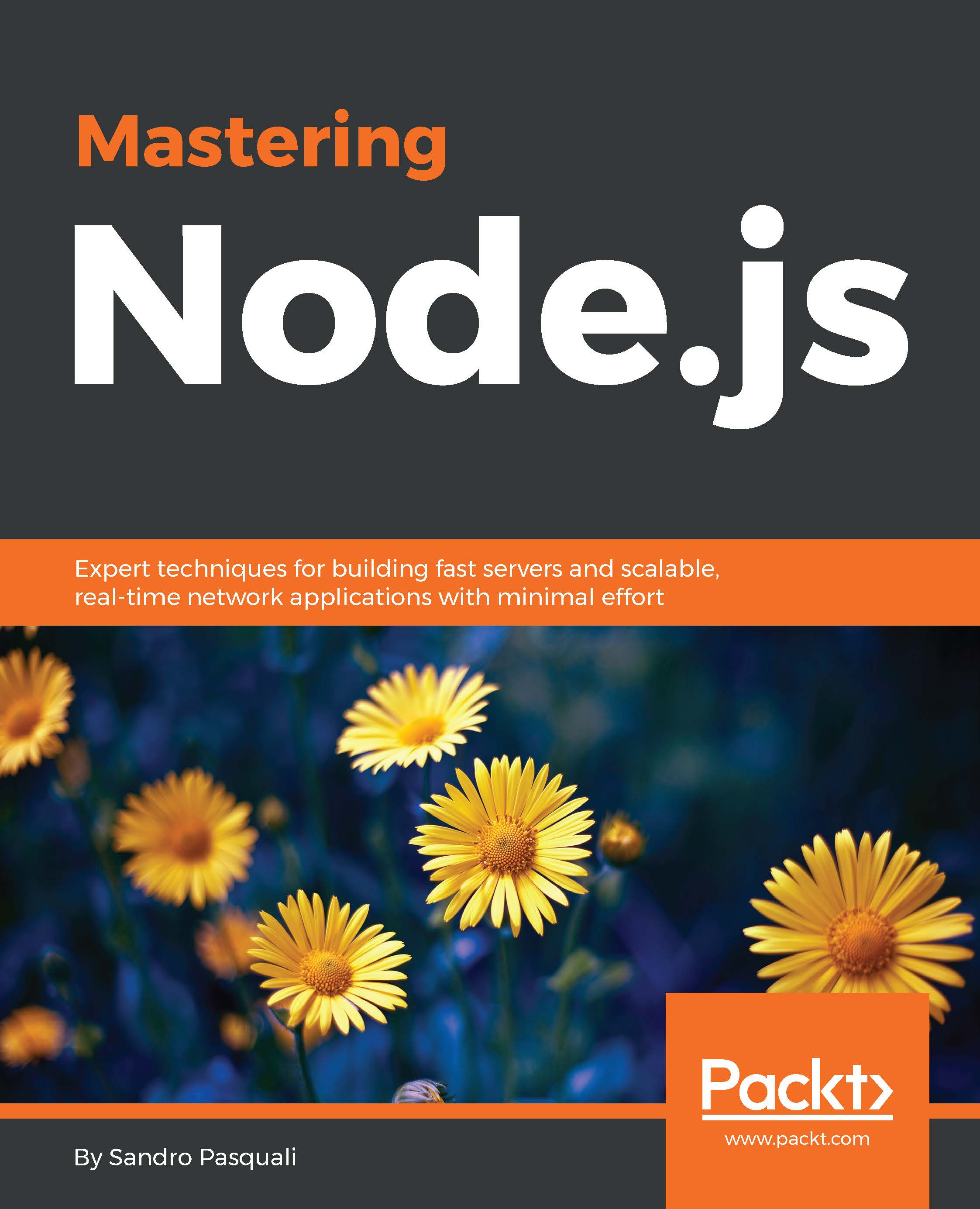
Mastering Node.js
Mastering Node.js

Mastering Node.js

Expert techniques for building fast servers and scalable, real-time network applications with minimal effort

€43.99
By Sandro Pasquali
Full star icon Full star icon Full star icon Full star icon Half star icon
4.4 (10 Ratings)
Pages 346
Published in Nov 2013
Product Type Paperback
Edition 1st Edition
ISBN 9781782166320
Mastering Node.js

Packt Subscriptions

See our plans and pricing
Modal Close icon
€11.99 billed monthly
Feature tick icon Unlimited access to Packt's library of 6,500+ practical books and videos
Feature tick icon Constantly refreshed with 50+ new titles a month
Feature tick icon Exclusive Early access to books as they're written
Feature tick icon Solve problems while you work with advanced search and reference features
Feature tick icon Offline reading on the mobile app
Feature tick icon Simple pricing, no contract
€119.99 billed annually
Feature tick icon Unlimited access to Packt's library of 6,500+ practical books and videos
Feature tick icon Constantly refreshed with 50+ new titles a month
Feature tick icon Exclusive Early access to books as they're written
Feature tick icon Solve problems while you work with advanced search and reference features
Feature tick icon Offline reading on the mobile app
Feature tick icon Choose a DRM-free eBook or Video every month to keep
Feature tick icon PLUS own as many other DRM-free eBooks or Videos as you like for just €5 each
Feature tick icon Exclusive print discounts
€169.99 billed in 18 months
Feature tick icon Unlimited access to Packt's library of 6,500+ practical books and videos
Feature tick icon Constantly refreshed with 50+ new titles a month
Feature tick icon Exclusive Early access to books as they're written
Feature tick icon Solve problems while you work with advanced search and reference features
Feature tick icon Offline reading on the mobile app
Feature tick icon Choose a DRM-free eBook or Video every month to keep
Feature tick icon PLUS own as many other DRM-free eBooks or Videos as you like for just €5 each
Feature tick icon Exclusive print discounts

What do you get with Print?

Product feature icon Instant access to your digital copy whilst your Print order is Shipped
Product feature icon Paperback book shipped to your preferred address
Product feature icon Redeem a companion digital copy on all Print orders
Product feature icon Access this title in our online reader with advanced features
Product feature icon DRM FREE - Read whenever, wherever and however you want
Table of content icon View table of contents Preview book icon Preview Book

Mastering Node.js

Chapter 2. Understanding Asynchronous Event-Driven Programming


The best way to predict the future is to invent it.

 
 --Alan Kay

Eliminating blocking processes through the use of event-driven, asynchronous I/O is Node's primary organizational principle. We've learned how this design helps developers in shaping information and adding capacity: lightweight, independent, and share-nothing processes communicating through callbacks synchronized within a predictable event loop.

Accompanying the growth in the popularity of Node is a growth in the number of well-designed evented systems and applications. For a new technology to be successful, it must eliminate existing problems and/or offer to consumers a better solution at a lower cost in terms of time or effort or price. In its short and fertile lifespan, the Node community has collaboratively proven that this new development model is a viable alternative to existing technologies. The number and quality of Node-based solutions powering enterprise...

Broadcasting events


It is always good to have an accurate understanding of the total eventual cost of asking for a service to be performed.

I/O is expensive. In the following chart (taken from Ryan Dahl's original presentation on Node) we can see how many clock cycles typical system tasks consume. The relative cost of I/O operations is striking.

L1 cache

3 cycles

L2 cache

14 cycles

RAM

250 cycles

Disk

41,000,000 cycles

Network

240,000,000 cycles

The reasons are clear enough: a disk is a physical device, a spinning metal platter that buses data at a speed that cannot possibly match the speed of an on-chip or near-chip cache moving data between the CPU and RAM (Random Access Memory). Similarly, a network is bound by the speed in which data can travel through its connecting "wires", modulated by its controllers. Even through fiber optic cables, light itself needs 0.1344 seconds to travel around the world. In a network used by billions of people regularly interacting across great distances...

Listening for events


In the previous chapter we were introduced to the EventEmitter interface. This is the primary event interface we will be encountering as we move chapter to chapter, as it provides the prototype class for the many Node objects exposing evented interfaces, such as file and network streams. Various close, exit, data, and other events exposed by different module APIs signal the presence of an EventEmitter interface, and we will be learning about these modules and use cases as we progress.

Instead, the primary purpose of this section is to discuss some lesser-known event sources—signals, child process communication, filesystem change events, and deferred execution.

Signals

In many ways, evented programming is like hardware interrupt programming. Interrupts do exactly what their name suggests. They use their ability to interrupt whatever a controller or the CPU or any other device is doing, demanding that their particular need be serviced immediately.

In fact, the Node process...

Timers


Timers are used to schedule events in the future. They are used when one seeks to delay the execution of some block of code until a specified number of milliseconds have passed, to schedule periodic execution of a particular function, or to slot some functionality immediately to the following.

JavaScript provides two asynchronous timers: setInterval() and setTimeout().

It is assumed that the reader is fully aware of how to set (and cancel) these timers, so very little time will be spent discussing the syntax. We'll instead focus more on "gotchas" and "less well-known" details about timeouts and intervals.

The key takeaway will be this: when using timers one should make no assumptions about the amount of actual time that will expire before the callback registered for this timer fires, or about the ordering of callbacks. Node timers are not interrupts. Timers simply promise to execute as close as possible to the specified time (though never before), beholden, as with every other event...

Understanding the event loop


Node processes JavaScript instructions using a single thread. Within your JavaScript program no two operations will ever execute at exactly the same moment, as might happen in a multithreaded environment. Understanding this fact is essential to understanding how a Node program, or process, is designed and runs.

This does not mean that only one thread is being used on the machine hosting this a Node process. Simply writing a callback does not magically create parallelism! Recall Chapter 1, Understanding the Node Environment, and our discussion about the process object—Node's "single thread" simplicity is in fact an abstraction created for the benefit of developers. It is nevertheless crucial to remember that there are many threads running in the background managing I/O (and other things), and these threads unpredictably insert instructions, originally packaged as callbacks, into the single JavaScript thread for processing.

Node executes instructions one by one until...

Callbacks and errors


Members of the Node community develop new packages and projects every day. Because of Node's evented nature, callbacks permeate these codebases. We've considered several of the key ways in which events might be queued, dispatched, and handled through the use of callbacks. Let's spend a little time outlining the best practices, in particular about conventions for designing callbacks and handling errors, and discuss some patterns useful when designing complex chains of events and callbacks.

Conventions

Luckily, Node creators agreed upon sane conventions on how to structure callbacks early on. It is important to follow this tradition. Deviation leads to surprises, sometimes very bad surprises, and in general to do so automatically makes an API awkward, a characteristic other developers will rapidly tire of.

One is either returning a function result by executing a callback, handling the arguments received by a callback, or designing the signature for a callback within your...

Listening for file changes


Let's apply what we've learned. The goal is to create a server that a client can connect to and receive updates from Twitter. We will first create a process to query Twitter for any messages with the hashtag #nodejs, and writes any found messages to a tweets.txt file in 140-byte chunks. We will then create a network server that broadcasts these messages to a single client. Those broadcasts will be triggered by write events on the tweets.txt file. Whenever a write occurs, 140-byte chunks are asynchronously read from the last known client read pointer. This will happen until we reach the end of the file, broadcasting as we go. Finally, we will create a simple client.html page, which asks for, receives, and displays these messages.

While this example is certainly contrived, it demonstrates:

  • Listening to the filesystem for changes and responding to those events

  • Using data stream events for reading and writing files

  • Responding to network events

  • Using timeouts for polling...

Summary


Programming with events is not always easy. The control and context switches, defining the paradigm often confound those new to evented systems. This seemingly reckless loss of control and the resulting complexity drives many developers away from these ideas. Students in introductory programming courses normally develop a mindset in which program flow can be dictated, where a program whose execution flow does not proceed sequentially from A to B can bend understanding.

By examining the evolution of the architectural problems Node is now attempting to solve for network applications—in terms of scaling, in terms of code organization, in general terms of data and complexity volume, in terms of state awareness, and in terms of well-defined data and process boundaries—we have learned how managing these event queues can be done intelligently. We have seen how different event sources are predictably stacked for an event loop to process, and how far-future events can enter and re-enter contexts...

Left arrow icon Right arrow icon
Download code icon Download Code

Key Benefits

Master the latest techniques for building real-time, big data applications, integrating Facebook, Twitter, and other network services
Tame asynchronous programming, the event loop, and parallel data processing
Use the Express and Path frameworks to speed up development and deliver scalable, higher quality software more quickly

What You Will Learn

Who Is This Book For?

If you've ever built a web page and would like to build network software using the language and style you already know, Node will make that process simple, and even fun. If you understand what a server is, what a client is, and how to write JavaScript, you are already halfway to mastering Node.js!

Book Description

Node.js is a modern development stack focused on providing an easy way to build scalable network software. Backed by a growing number of large companies and a rapidly increasing developer base, Node is revolutionizing the way that software is being built today. Powered by Google's V8 engine and built out of C++ modules, this is a JavaScript environment for the enterprise.Mastering Node.js will take the reader deep into this exciting development environment. Beginning with a comprehensive breakdown of its innovative non-blocking evented design, Node's structure is explained in detail, laying out how its blazingly fast I/O performance simplifies the creation of fast servers, scalable architectures, and responsive web applications.Mastering Node.js takes you through a concise yet thorough tour of Node's innovative evented non-blocking design, showing you how to build professional applications with the help of detailed examples.Learn how to integrate your applications with Facebook and Twitter, Amazon and Google, creating social apps and programs reaching thousands of collaborators on the cloud. See how the Express and Path frameworks make the creation of professional web applications painless. Set up one, two, or an entire server cluster with just a few lines of code, ready to scale as soon as you're ready to launch. Move data seamlessly between databases and file systems, between clients, and across network protocols, using a beautifully designed, consistent, and predictable set of tools.Mastering Node.js contains all of the examples and explanations you'll need to build applications in a short amount of time and at a low cost, running on a scale and speed that would have been nearly impossible just a few years ago.

Category:
Languages:
Concepts:
Tools:

Frequently bought together


Stars icon
Total 131.97
Mastering Node.js
€43.99
Node.js Blueprints
€45.99
Node Cookbook: Second Edition
€41.99
Total 131.97 Stars icon

Table of Contents

(9 Chapters)
Understanding the Node Environment Chevron down icon Chevron up icon
Understanding Asynchronous Event-Driven Programming Chevron down icon Chevron up icon
Streaming Data Across Nodes and Clients Chevron down icon Chevron up icon
Using Node to Access the Filesystem Chevron down icon Chevron up icon
Managing Many Simultaneous Client Connections Chevron down icon Chevron up icon
Creating Real-time Applications Chevron down icon Chevron up icon
Utilizing Multiple Processes Chevron down icon Chevron up icon
Scaling Your Application Chevron down icon Chevron up icon
Testing your Application Chevron down icon Chevron up icon

Customer reviews

Top Reviews
Rating distribution
Full star icon Full star icon Full star icon Full star icon Half star icon
4.4
(10 Ratings)
5 star 80%
4 star 0%
3 star 10%
2 star 0%
1 star 10%
Filter icon Filter
Top Reviews

Filter reviews by


Jools Feb 11, 2014
Full star icon Full star icon Full star icon Full star icon Full star icon
5
This book is indeed about 'mastering' node. It is a book for the professional with a need to understand where the true strengths of the framework lie. Above all it dispenses with the notion that node can't 'do' multi-CPU machines and elegantly explains why the node solution will trump the old multi-threaded blocking options.I was relieved to find there is no 'introduction' to the javascript language (for example). The book assumes you are familiar with node already. Indeed you are really straight 'in there' with e.g. Streams2, scaling servers and child process forking; which is just what I wanted as there is a paucity of documentation and discussion about node.js out there, even on Stackoverflow. This book contains quite a lot more information and guidance than I could find on the internet, so for me it is a good buy. As usual with all tech books, the program examples don't render well on Kindle, so this time I bought the hardcopy !
Amazon Verified review Amazon
ELIAS POLITAKIS Oct 22, 2015
Full star icon Full star icon Full star icon Full star icon Full star icon
5
An excellent book on the internals of Node.js that covers almost EVERY aspect for producing scalable Network Servers, but sadly not in the depth I was expecting. Still, the book covers libuv Event Loop, node.js processes and forks, CPU clustering with HTTP Server example, Socket I/O and Streams, Session Management tools such as Redis, Reverse Proxies and RabbitMQ, Errors and Exceptions, Amazon Web Services and a little of Native C++ Addons. The book's figures are not brilliant as the author fails big-time to produce understandable drawings (I had to scratch my head a lot until I could understand them) and it does not get into technologies such as MemCached or Redis too much. Still, you can get up-to-speed with Node.js in just 48 hours and seek other material from there. HIGHLY RECOMMENDED for newbies into node.js advanced programming.
Amazon Verified review Amazon
Amazon Customer Jan 03, 2017
Full star icon Full star icon Full star icon Full star icon Full star icon
5
Nice book. Though, it is not for beginners. You must be familiar with Node.js before giving it a try. As the name suggests, 'Mastering Node.js', for getting mastery over the subject, you can go for this book.
Amazon Verified review Amazon
Rakesh Oct 20, 2014
Full star icon Full star icon Full star icon Full star icon Full star icon
5
Not sure why this is not being recommended by people(...marketing failure?). This is a must have book for mastering theory(along with some practice) of Node.js. I like detailed theory before diving into a technology, and this book explains it beautifully. I skimmed through few famous node books, but all of them(yes, all of them) fall short on explaining how node works.
Amazon Verified review Amazon
Timothy Ha Nov 28, 2014
Full star icon Full star icon Full star icon Full star icon Full star icon
5
This is clearly not a book for novice programmers wanting to learn a new and trendy thing. But if you're someone who is making choices for your own projects or your company's ones, please take a look at this book. It clearly explains why Node.js is a smart and scalable solution, it gives you understanding how you will use Node.js in the overall architecture of your services. The book is a good blend of theoretical musings (like threads v.s. event loop) and links to proven components for a Node.js-based solution (like Express framework, nginx, nodejitsu and so on).
Amazon Verified review Amazon
Get free access to Packt library with over 7500+ books and video courses for 7 days!
Start Free Trial

FAQs

What is the delivery time and cost of print book? Chevron down icon Chevron up icon

Shipping Details

USA:

'

Economy: Delivery to most addresses in the US within 10-15 business days

Premium: Trackable Delivery to most addresses in the US within 3-8 business days

UK:

Economy: Delivery to most addresses in the U.K. within 7-9 business days.
Shipments are not trackable

Premium: Trackable delivery to most addresses in the U.K. within 3-4 business days!
Add one extra business day for deliveries to Northern Ireland and Scottish Highlands and islands

EU:

Premium: Trackable delivery to most EU destinations within 4-9 business days.

Australia:

Economy: Can deliver to P. O. Boxes and private residences.
Trackable service with delivery to addresses in Australia only.
Delivery time ranges from 7-9 business days for VIC and 8-10 business days for Interstate metro
Delivery time is up to 15 business days for remote areas of WA, NT & QLD.

Premium: Delivery to addresses in Australia only
Trackable delivery to most P. O. Boxes and private residences in Australia within 4-5 days based on the distance to a destination following dispatch.

India:

Premium: Delivery to most Indian addresses within 5-6 business days

Rest of the World:

Premium: Countries in the American continent: Trackable delivery to most countries within 4-7 business days

Asia:

Premium: Delivery to most Asian addresses within 5-9 business days

Disclaimer:
All orders received before 5 PM U.K time would start printing from the next business day. So the estimated delivery times start from the next day as well. Orders received after 5 PM U.K time (in our internal systems) on a business day or anytime on the weekend will begin printing the second to next business day. For example, an order placed at 11 AM today will begin printing tomorrow, whereas an order placed at 9 PM tonight will begin printing the day after tomorrow.


Unfortunately, due to several restrictions, we are unable to ship to the following countries:

  1. Afghanistan
  2. American Samoa
  3. Belarus
  4. Brunei Darussalam
  5. Central African Republic
  6. The Democratic Republic of Congo
  7. Eritrea
  8. Guinea-bissau
  9. Iran
  10. Lebanon
  11. Libiya Arab Jamahriya
  12. Somalia
  13. Sudan
  14. Russian Federation
  15. Syrian Arab Republic
  16. Ukraine
  17. Venezuela
What is custom duty/charge? Chevron down icon Chevron up icon

Customs duty are charges levied on goods when they cross international borders. It is a tax that is imposed on imported goods. These duties are charged by special authorities and bodies created by local governments and are meant to protect local industries, economies, and businesses.

Do I have to pay customs charges for the print book order? Chevron down icon Chevron up icon

The orders shipped to the countries that are listed under EU27 will not bear custom charges. They are paid by Packt as part of the order.

List of EU27 countries: www.gov.uk/eu-eea:

A custom duty or localized taxes may be applicable on the shipment and would be charged by the recipient country outside of the EU27 which should be paid by the customer and these duties are not included in the shipping charges been charged on the order.

How do I know my custom duty charges? Chevron down icon Chevron up icon

The amount of duty payable varies greatly depending on the imported goods, the country of origin and several other factors like the total invoice amount or dimensions like weight, and other such criteria applicable in your country.

For example:

  • If you live in Mexico, and the declared value of your ordered items is over $ 50, for you to receive a package, you will have to pay additional import tax of 19% which will be $ 9.50 to the courier service.
  • Whereas if you live in Turkey, and the declared value of your ordered items is over € 22, for you to receive a package, you will have to pay additional import tax of 18% which will be € 3.96 to the courier service.
How can I cancel my order? Chevron down icon Chevron up icon

Cancellation Policy for Published Printed Books:

You can cancel any order within 1 hour of placing the order. Simply contact [email protected] with your order details or payment transaction id. If your order has already started the shipment process, we will do our best to stop it. However, if it is already on the way to you then when you receive it, you can contact us at [email protected] using the returns and refund process.

Please understand that Packt Publishing cannot provide refunds or cancel any order except for the cases described in our Return Policy (i.e. Packt Publishing agrees to replace your printed book because it arrives damaged or material defect in book), Packt Publishing will not accept returns.

What is your returns and refunds policy? Chevron down icon Chevron up icon

Return Policy:

We want you to be happy with your purchase from Packtpub.com. We will not hassle you with returning print books to us. If the print book you receive from us is incorrect, damaged, doesn't work or is unacceptably late, please contact Customer Relations Team on [email protected] with the order number and issue details as explained below:

  1. If you ordered (eBook, Video or Print Book) incorrectly or accidentally, please contact Customer Relations Team on [email protected] within one hour of placing the order and we will replace/refund you the item cost.
  2. Sadly, if your eBook or Video file is faulty or a fault occurs during the eBook or Video being made available to you, i.e. during download then you should contact Customer Relations Team within 14 days of purchase on [email protected] who will be able to resolve this issue for you.
  3. You will have a choice of replacement or refund of the problem items.(damaged, defective or incorrect)
  4. Once Customer Care Team confirms that you will be refunded, you should receive the refund within 10 to 12 working days.
  5. If you are only requesting a refund of one book from a multiple order, then we will refund you the appropriate single item.
  6. Where the items were shipped under a free shipping offer, there will be no shipping costs to refund.

On the off chance your printed book arrives damaged, with book material defect, contact our Customer Relation Team on [email protected] within 14 days of receipt of the book with appropriate evidence of damage and we will work with you to secure a replacement copy, if necessary. Please note that each printed book you order from us is individually made by Packt's professional book-printing partner which is on a print-on-demand basis.

What tax is charged? Chevron down icon Chevron up icon

Currently, no tax is charged on the purchase of any print book (subject to change based on the laws and regulations). A localized VAT fee is charged only to our European and UK customers on eBooks, Video and subscriptions that they buy. GST is charged to Indian customers for eBooks and video purchases.

What payment methods can I use? Chevron down icon Chevron up icon

You can pay with the following card types:

  1. Visa Debit
  2. Visa Credit
  3. MasterCard
  4. PayPal
What is the delivery time and cost of print books? Chevron down icon Chevron up icon

Shipping Details

USA:

'

Economy: Delivery to most addresses in the US within 10-15 business days

Premium: Trackable Delivery to most addresses in the US within 3-8 business days

UK:

Economy: Delivery to most addresses in the U.K. within 7-9 business days.
Shipments are not trackable

Premium: Trackable delivery to most addresses in the U.K. within 3-4 business days!
Add one extra business day for deliveries to Northern Ireland and Scottish Highlands and islands

EU:

Premium: Trackable delivery to most EU destinations within 4-9 business days.

Australia:

Economy: Can deliver to P. O. Boxes and private residences.
Trackable service with delivery to addresses in Australia only.
Delivery time ranges from 7-9 business days for VIC and 8-10 business days for Interstate metro
Delivery time is up to 15 business days for remote areas of WA, NT & QLD.

Premium: Delivery to addresses in Australia only
Trackable delivery to most P. O. Boxes and private residences in Australia within 4-5 days based on the distance to a destination following dispatch.

India:

Premium: Delivery to most Indian addresses within 5-6 business days

Rest of the World:

Premium: Countries in the American continent: Trackable delivery to most countries within 4-7 business days

Asia:

Premium: Delivery to most Asian addresses within 5-9 business days

Disclaimer:
All orders received before 5 PM U.K time would start printing from the next business day. So the estimated delivery times start from the next day as well. Orders received after 5 PM U.K time (in our internal systems) on a business day or anytime on the weekend will begin printing the second to next business day. For example, an order placed at 11 AM today will begin printing tomorrow, whereas an order placed at 9 PM tonight will begin printing the day after tomorrow.


Unfortunately, due to several restrictions, we are unable to ship to the following countries:

  1. Afghanistan
  2. American Samoa
  3. Belarus
  4. Brunei Darussalam
  5. Central African Republic
  6. The Democratic Republic of Congo
  7. Eritrea
  8. Guinea-bissau
  9. Iran
  10. Lebanon
  11. Libiya Arab Jamahriya
  12. Somalia
  13. Sudan
  14. Russian Federation
  15. Syrian Arab Republic
  16. Ukraine
  17. Venezuela
Modal Close icon

Loading shipping options...

Unable to load shipping costs. Please try again later.

Estimated Shipping Cost

Deliver to -
Modal Close icon
Modal Close icon