

Search icon CANCEL
Subscription
0
Cart icon
Your Cart (0 item)
Close icon
You have no products in your basket yet
Save more on your purchases! discount-offer-chevron-icon
Savings automatically calculated. No voucher code required.
Arrow left icon
Explore Products
Best Sellers
New Releases
Books
Videos
Audiobooks
Learning Hub
Newsletter Hub
Free Learning
Arrow right icon
timer SALE ENDS IN
0 Days
:
00 Hours
:
00 Minutes
:
00 Seconds
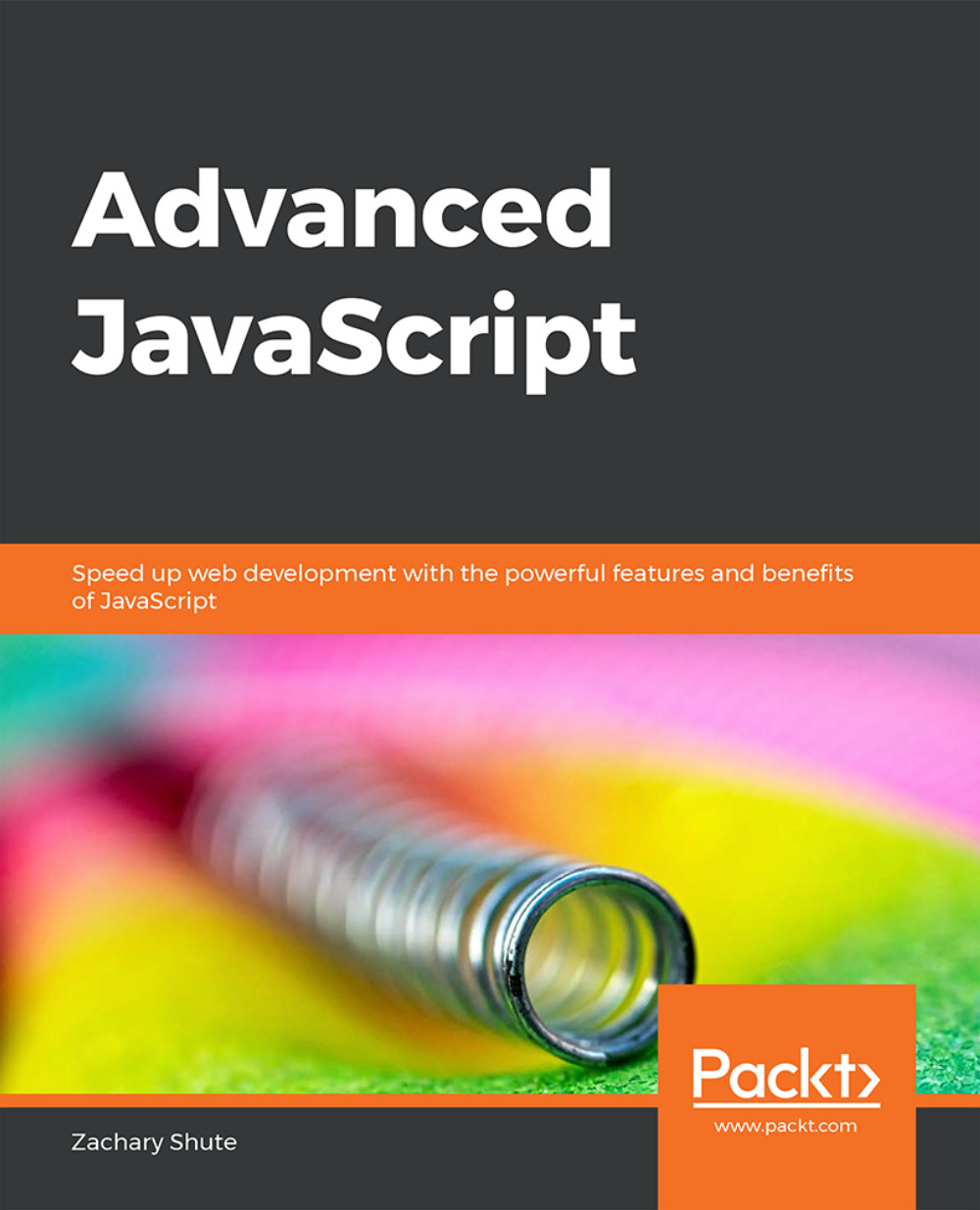
Advanced JavaScript
Advanced JavaScript

Advanced JavaScript

Speed up web development with the powerful features and benefits of JavaScript

$38.99
By Zachary Shute
Full star icon Full star icon Full star icon Half star icon Empty star icon
3.7 (3 Ratings)
Pages 330
Published in Jan 2019
Product Type Paperback
Edition 1st Edition
ISBN 9781789800104
Advanced JavaScript

Packt Subscriptions

See our plans and pricing
Modal Close icon
$12.99 billed monthly
Feature tick icon Unlimited access to Packt's library of 6,500+ practical books and videos
Feature tick icon Constantly refreshed with 50+ new titles a month
Feature tick icon Exclusive Early access to books as they're written
Feature tick icon Solve problems while you work with advanced search and reference features
Feature tick icon Offline reading on the mobile app
Feature tick icon Simple pricing, no contract
$129.99 billed annually
Feature tick icon Unlimited access to Packt's library of 6,500+ practical books and videos
Feature tick icon Constantly refreshed with 50+ new titles a month
Feature tick icon Exclusive Early access to books as they're written
Feature tick icon Solve problems while you work with advanced search and reference features
Feature tick icon Offline reading on the mobile app
Feature tick icon Choose a DRM-free eBook or Video every month to keep
Feature tick icon PLUS own as many other DRM-free eBooks or Videos as you like for just $5 each
Feature tick icon Exclusive print discounts
$179.99 billed in 18 months
Feature tick icon Unlimited access to Packt's library of 6,500+ practical books and videos
Feature tick icon Constantly refreshed with 50+ new titles a month
Feature tick icon Exclusive Early access to books as they're written
Feature tick icon Solve problems while you work with advanced search and reference features
Feature tick icon Offline reading on the mobile app
Feature tick icon Choose a DRM-free eBook or Video every month to keep
Feature tick icon PLUS own as many other DRM-free eBooks or Videos as you like for just $5 each
Feature tick icon Exclusive print discounts

What do you get with Print?

Product feature icon Instant access to your digital copy whilst your Print order is Shipped
Product feature icon Paperback book shipped to your preferred address
Product feature icon Redeem a companion digital copy on all Print orders
Product feature icon Access this title in our online reader with advanced features
Product feature icon DRM FREE - Read whenever, wherever and however you want
Product feature icon AI Assistant (beta) to help accelerate your learning
Table of content icon View table of contents Preview book icon Preview Book

Advanced JavaScript

Introducing ECMAScript 6

Learning Objectives

By the end of this chapter, you will be able to:

  • Define the different scopes in JavaScript and characterize variable declaration
  • Simplify JavaScript object definitions
  • Destructure objects and arrays, and build classes and modules
  • Transpile JavaScript for compatibility
  • Compose iterators and generators

In this chapter, you'll be learning how to use the new syntax and concepts of ECMAScript.

Introduction

JavaScript, often abbreviated as JS, is a programming language designed to allow the programmer to build interactive web applications. JavaScript is one of the backbones of web development, along with HTML and CSS. Nearly every major website, including Google, Facebook, and Netflix, make heavy use of JavaScript. JS was first created for the Netscape web browser in 1995. The first prototype of JavaScript was written by Brendan Eich in just a mere 10 days. Since its creation, JavaScript has become one of the most common programming languages in use today.

In this book, we will deepen your understanding of the core of JavaScript and its advanced functionality. We will cover the new features that have been introduced in the ECMAScript standard, JavaScript's asynchronous programming nature, DOM and HTML event interaction with JavaScript, JavaScript's functional programming paradigms, testing JavaScript code, and the JavaScript development environment...

Beginning with ECMAScript

ECMAScript is a scripting language specification standardized by ECMA International. It was created to standardize JavaScript in an attempt to allow for independent and compatible implementations. ECMAScript 6, or ES6, was originally released in 2015 and has gone through several minor updates since then.

Note

You may refer to the following link for more information about ECMA specification:https://developer.mozilla.org/en-US/docs/Web/JavaScript/Language_Resources.

Understanding Scope

In computer science, scope is the region of a computer program where the binding or association of a name to an entity, such as a variable or function, is valid. JavaScript has the following two distinct types of scope:

  • Function scope
  • Block scope

Until ES6, function scope was the only form of scope in JavaScript; all variable and function declarations followed function scope rules. Block scope was introduced in ES6 and is used only by the variables declared with the new variable declaration keywords let and const. These keywords are discussed in detail in the Declaring Variables section.

Function Scope

Function scope in JavaScript is created inside functions. When a function is declared, a new scope block is created inside the body of that function. Variables that are declared inside the new function scope cannot be accessed from the parent scope; however, the function scope has access to variables in the parent scope...

Declaring Variables

Basic JavaScript uses the keyword var for variable declaration. ECMAScript 6 introduced two new keywords to declare variables; they are let and const. In the world of Professional JavaScript variable declaration, var is now the weakest link. In this topic, we will go over the new keywords, let and const, and explain why they are better than var.

The three ways to declare variables in JavaScript are by using var, let, and const. All function in slightly different ways. The key differences between the three variable declaration keywords are the way they handle variable reassignment, variable scope, and variable hoisting. These three features can be explained briefly as follows:

Variable reassignment: The ability to change or reassign the variable's value at any time.

Variable scope: The extent or area of the code from which the variable may be accessed.

Variable hoisting: The variable instantiation and assignment time in relation to the...

Introducing Arrow Functions

Arrow functions, or Fat arrow functions, are a new way to create functions in ECMAScript 6. Arrow functions simplify function syntax. They are called fat arrow functions because they are denoted with the characters =>, which, when put together look like a fat arrow. Arrow functions in JavaScript are frequently used in callback chains, promise chains, array methods, in any situation where unregistered functions would be useful.

The key difference between arrow functions and normal functions in JavaScript is that arrow functions are anonymous. Arrow functions are not named and not bound to an identifier. This means that an arrow function is created dynamically and is not given a name like normal functions. Arrow functions can however be assigned to a variable to allow for reuse.

When creating an arrow function, all we need to do is remove the function keyword and place an arrow between the function arguments and function body. Arrow functions are...

Learning Template Literals

Template literals are a new form of string that was introduced in ECMAScript 6. They are enclosed by the backtick symbol (``) instead of the usual single or double quotes. Template literals allow you to embed expressions in the string that are evaluated at runtime. Thus, we can easily create dynamic strings from variables and variable expressions. These expressions are denoted with the dollar sign and curly braces (${ expression }). The template literal syntax is shown in the following code:

const example = "pretty";
console.log( `Template literals are ${ example } useful!!!` ); 
// Expected output: Template literals are pretty useful!!!
Snippet 1.22: Template literal basic syntax

Template literals are escaped like other strings in JavaScript. To escape a template literal, simply use a backslash (\) character. For example, the following equalities evaluate to true: `\`` === "`",`\t` === "\t", and `\n\r` === "\n...

Enhanced Object Properties

ECMAScript 6 added several enhancements to object literals as part of the ES6 syntactic sugar. ES6 added three ways to simplify the creation of object literals. These simplifications include a more concise syntax for initializing object properties from variables, a more concise syntax for defining function methods, and computed object property names.

Note

Syntactic sugar is a syntax that is designed to make expressions easier to read and express. It makes the syntax "sweeter" because code can be expressed concisely.

Object Properties

The shorthand for initializing object properties allows you to make more concise objects. In ES5, we needed to define the object properties with a key name and a value, as shown in the following code:

function getPersionES5( name, age, height ) {
  return {
    name: name,
    age: age,
    height: height
  };
...

Destructuring Assignment

Destructuring assignment is syntax in JavaScript that allows you to unpack values from arrays or properties from objects, and save them into variables. It is a very handy feature because we can extract data directly from arrays and objects to save into variables, all on a single line of code. It is powerful because it enables us to extract multiple array elements or object properties in the same expression.

Array Destructuring

Array destructuring allows us to extract multiple array elements and save them into variables. In ES5, we do this by defining each variable with its array value, one variable at a time. This makes the code lengthy and increases the time required to write it.

In ES6, to destructure an array, we simply create an array containing the variable to assign data into, and set it equal to the data array being destructured. The values in the array are unpacked and assigned to the variables in the left-hand side array from left to right...

Classes and Modules

Classes and Modules were added to ES6. Classes were introduced as a way to expand on prototype-based inheritance by adding some object oriented concepts. Modules were introduced as a way to organize multiple code files in JavaScript and expand on code reusability and scoping among files.

Classes

Classes were added to ECMAScript 6 primarily as syntactic sugar to expand on the existing prototype-based inheritance structure. Class syntax does not introduce object oriented inheritance to JavaScript. Class inheritance in JavaScript do not work like classes in object oriented languages.

In JavaScript, a class can be defined with the keyword class. A class is created by calling the keyword class, followed by the class name and curly braces. Inside the curly braces, we define all of the functions and logic for the class. The syntax is as follows:

class name { /* class stuff goes here */ }
Snippet 1.58: Class syntax

A class can be created with the...

Transpilation

Transpilation is defined as source-to-source compilation. Tools have been written to do this and they are called transpilers. Transpilers take the source code and convert it into another language. Transpilers are important for two reasons. First, not every browser supports every new syntax in ES6, and second, many developers use programming languages based off of JavaScript, such as CoffeeScript or TypeScript.

Note

The ES6 compatibility table can be found at https://kangax.github.io/compat-table/es6/

Looking at the ES6 browser compatibility table clearly shows us that there are some holes in support. A transpiler allows us to write our code in ES6 and translate it into vanilla ES5, which works in every browser. It is critical to ensure that our code works on as many web platforms as possible. Transpilers can be an invaluable tool for ensuring compatibility.

Transpilers also allow us to develop web or server side applications in other programming languages...

Iterators and Generators

In their simplest forms, iterators and generators are two ways to process a collection of data incrementally. They gain efficiency over loops by keeping track of the state of the collection instead of all of the items in the collection.

Iterators

An iterator is a way to traverse through data in a collection. To iterate over a data structure means to step through each of its elements in order. For example, the for/in loop is a method that's used to iterate over the keys in a JavaScript object. An object is an iterator when it knows how to access its items from a collection one at a time, while tracking position and finality. An iterator can be used to traverse custom complicated data structure or for traversing chunks of large data that may not be practical to load all at once.

To create an iterator, we must define a function that takes a collection in as the parameter and returns an object. The return object must have a function property called...

Summary

In this chapter, we saw how ECMAScript is a scripting language specification for modern JavaScript. ECMAScript 6, or ES6, was released in 2015. Through this chapter, we covered some of the various key points of ES6 and their differences from previous versions of JavaScript. We highlighted the rules of variable scoping, the keywords for declaring variables, fat arrow function syntax, template literals, enhanced object property notation, destructuring assignment, classes and modules, transpilation, and iterators and generators. You are ready to begin applying this knowledge to your professional JavaScript projects.

In the next chapter, we will learn what an asynchronous programming language is and how to write and understand asynchronous code.

Left arrow icon Right arrow icon

Key Benefits

Explore the new ES6 syntax, the event loop, and asynchronous programming
Learn the test-driven development approach when building apps
Master advanced JavaScript concepts to enhance your web developments skill

What You Will Learn

Who Is This Book For?

This book is designed to target anyone who wants to write JavaScript in a professional environment. We expect the audience to have used JavaScript in some capacity and be familiar with the basic syntax. This book would be good for a tech enthusiast wondering when to use generators or how to use Promises and Callbacks effectively, or a novice developer who wants to deepen their knowledge on JavaScript and understand TDD.

Book Description

If you are looking for a programming language to develop flexible and efficient applications, JavaScript is an obvious choice. Advanced JavaScript is a hands-on guide that takes you through JavaScript and its many features, one step at a time. You'll begin by learning how to use the new JavaScript syntax in ES6, and then work through the many other features that modern JavaScript has to offer. As you progress through the chapters, you’ll use asynchronous programming with callbacks and promises, handle browser events, and perform Document Object Model (DOM) manipulation. You'll also explore various methods of testing JavaScript projects. In the concluding chapters, you'll discover functional programming and learn to use it to build your apps. With this book as your guide, you'll also be able to develop APIs using Node.js and Express, create front-ends using React/Redux, and build mobile apps using React/Expo. By the end of Advanced JavaScript, you will have explored the features and benefits of JavaScript to build small applications.
Category:
Languages:
Concepts:
Tools:

Frequently bought together


Stars icon
Total $ 131.97
Modern JavaScript Web Development Cookbook
$48.99
Professional JavaScript
$43.99
Advanced JavaScript
$38.99
Total $ 131.97 Stars icon

Table of Contents

(12 Chapters)
Chapter 1 Chevron down icon Chevron up icon
Introducing ECMAScript 6 Chevron down icon Chevron up icon
Chapter 2 Chevron down icon Chevron up icon
Asynchronous JavaScript Chevron down icon Chevron up icon
Chapter 3 Chevron down icon Chevron up icon
DOM Manipulation and Event Handling Chevron down icon Chevron up icon
Chapter 4 Chevron down icon Chevron up icon
Testing JavaScript Chevron down icon Chevron up icon
Chapter 5 Chevron down icon Chevron up icon
Functional Programming Chevron down icon Chevron up icon
Chapter 6 Chevron down icon Chevron up icon
The JavaScript Ecosystem Chevron down icon Chevron up icon

Customer reviews

Rating distribution
Full star icon Full star icon Full star icon Half star icon Empty star icon
3.7
(3 Ratings)
5 star 33.3%
4 star 0%
3 star 66.7%
2 star 0%
1 star 0%
FM Jul 02, 2022
Full star icon Full star icon Full star icon Full star icon Full star icon
5
Forget about what people are saying below about the book and the dumb reviews. This book is by far the best JS book I've ordered so far! It's modern JS, covers all the points you need and more. If you want a book about design patterns, look elsewhere. But design paterns are general and applicable to (almost) every programming language out there. The book does what says on the cover, shows you concepts both basic and advanced! 5 stars from me!
Amazon Verified review Amazon
Scott J Pearson Aug 15, 2021
Full star icon Full star icon Full star icon Empty star icon Empty star icon
3
In the past decade, the JavaScript language has witnessed a renaissance of new activity. Once pigeon-holed as a language for web browser eye-candy, JavaScript can now be used for the entire stack (server-side, client-side, testing, and even command-line). In this book, Shute attempts to keep developers up to date with a high-level review of the advancements. While this book is not a classic (and what modern computer-language-specific book is a classic?), it serves the needs of the IT community quite well.Shute starts by informing readers about the modernization of JavaScript in a form cryptically called ES6. This language allows for more compact and more powerful expression, including new features dealing with asynchronous functions. Most programmers who have done a deep dive into some form of JavaScript are familiar with the challenges of its asynchronous nature.In case anyone is still not familiar with the Document Object Model (DOM) and jQuery, a tutorial is provided. (Most programmers will likely not gain much other than review from this section.) A section on automated testing is provided along with a conceptual introduction to functional programming. Finally, the “ecosystem” of Node.js, Express, and React are described in broader terms.As you can see, Shute does not miss much of the recent developments. However, he stays pretty high in his overview and provides few deep dives to entertain readers as well. This is the main limitation of the book. For instance, I bought another book on Node.js to supplement while reading this one. That said, this book did inspire me to buy a book instead of merely being bored in the first place – a definite accomplishment.This book’s intended audience really consists of only the software development community – hence its higher price-tag. The materials were put together well with a sturdy cover and clear font. Due to the technical content, few pictures accompany the text. Overall, this book updated me on a high level but left me wanting to take a deep dive or two into more difficult (and interesting) topics.
Amazon Verified review Amazon
Mark cooper Feb 24, 2021
Full star icon Full star icon Full star icon Empty star icon Empty star icon
3
Decent overview of several core Javascript areas. A little disjointed (went from a chapter on asynchronous programming to one on the DOM and jQuery) but overall worth the money.
Amazon Verified review Amazon
Get free access to Packt library with over 7500+ books and video courses for 7 days!
Start Free Trial

FAQs

What is the delivery time and cost of print book? Chevron down icon Chevron up icon

Shipping Details

USA:

'

Economy: Delivery to most addresses in the US within 10-15 business days

Premium: Trackable Delivery to most addresses in the US within 3-8 business days

UK:

Economy: Delivery to most addresses in the U.K. within 7-9 business days.
Shipments are not trackable

Premium: Trackable delivery to most addresses in the U.K. within 3-4 business days!
Add one extra business day for deliveries to Northern Ireland and Scottish Highlands and islands

EU:

Premium: Trackable delivery to most EU destinations within 4-9 business days.

Australia:

Economy: Can deliver to P. O. Boxes and private residences.
Trackable service with delivery to addresses in Australia only.
Delivery time ranges from 7-9 business days for VIC and 8-10 business days for Interstate metro
Delivery time is up to 15 business days for remote areas of WA, NT & QLD.

Premium: Delivery to addresses in Australia only
Trackable delivery to most P. O. Boxes and private residences in Australia within 4-5 days based on the distance to a destination following dispatch.

India:

Premium: Delivery to most Indian addresses within 5-6 business days

Rest of the World:

Premium: Countries in the American continent: Trackable delivery to most countries within 4-7 business days

Asia:

Premium: Delivery to most Asian addresses within 5-9 business days

Disclaimer:
All orders received before 5 PM U.K time would start printing from the next business day. So the estimated delivery times start from the next day as well. Orders received after 5 PM U.K time (in our internal systems) on a business day or anytime on the weekend will begin printing the second to next business day. For example, an order placed at 11 AM today will begin printing tomorrow, whereas an order placed at 9 PM tonight will begin printing the day after tomorrow.


Unfortunately, due to several restrictions, we are unable to ship to the following countries:

  1. Afghanistan
  2. American Samoa
  3. Belarus
  4. Brunei Darussalam
  5. Central African Republic
  6. The Democratic Republic of Congo
  7. Eritrea
  8. Guinea-bissau
  9. Iran
  10. Lebanon
  11. Libiya Arab Jamahriya
  12. Somalia
  13. Sudan
  14. Russian Federation
  15. Syrian Arab Republic
  16. Ukraine
  17. Venezuela
What is custom duty/charge? Chevron down icon Chevron up icon

Customs duty are charges levied on goods when they cross international borders. It is a tax that is imposed on imported goods. These duties are charged by special authorities and bodies created by local governments and are meant to protect local industries, economies, and businesses.

Do I have to pay customs charges for the print book order? Chevron down icon Chevron up icon

The orders shipped to the countries that are listed under EU27 will not bear custom charges. They are paid by Packt as part of the order.

List of EU27 countries: www.gov.uk/eu-eea:

A custom duty or localized taxes may be applicable on the shipment and would be charged by the recipient country outside of the EU27 which should be paid by the customer and these duties are not included in the shipping charges been charged on the order.

How do I know my custom duty charges? Chevron down icon Chevron up icon

The amount of duty payable varies greatly depending on the imported goods, the country of origin and several other factors like the total invoice amount or dimensions like weight, and other such criteria applicable in your country.

For example:

  • If you live in Mexico, and the declared value of your ordered items is over $ 50, for you to receive a package, you will have to pay additional import tax of 19% which will be $ 9.50 to the courier service.
  • Whereas if you live in Turkey, and the declared value of your ordered items is over € 22, for you to receive a package, you will have to pay additional import tax of 18% which will be € 3.96 to the courier service.
How can I cancel my order? Chevron down icon Chevron up icon

Cancellation Policy for Published Printed Books:

You can cancel any order within 1 hour of placing the order. Simply contact [email protected] with your order details or payment transaction id. If your order has already started the shipment process, we will do our best to stop it. However, if it is already on the way to you then when you receive it, you can contact us at [email protected] using the returns and refund process.

Please understand that Packt Publishing cannot provide refunds or cancel any order except for the cases described in our Return Policy (i.e. Packt Publishing agrees to replace your printed book because it arrives damaged or material defect in book), Packt Publishing will not accept returns.

What is your returns and refunds policy? Chevron down icon Chevron up icon

Return Policy:

We want you to be happy with your purchase from Packtpub.com. We will not hassle you with returning print books to us. If the print book you receive from us is incorrect, damaged, doesn't work or is unacceptably late, please contact Customer Relations Team on [email protected] with the order number and issue details as explained below:

  1. If you ordered (eBook, Video or Print Book) incorrectly or accidentally, please contact Customer Relations Team on [email protected] within one hour of placing the order and we will replace/refund you the item cost.
  2. Sadly, if your eBook or Video file is faulty or a fault occurs during the eBook or Video being made available to you, i.e. during download then you should contact Customer Relations Team within 14 days of purchase on [email protected] who will be able to resolve this issue for you.
  3. You will have a choice of replacement or refund of the problem items.(damaged, defective or incorrect)
  4. Once Customer Care Team confirms that you will be refunded, you should receive the refund within 10 to 12 working days.
  5. If you are only requesting a refund of one book from a multiple order, then we will refund you the appropriate single item.
  6. Where the items were shipped under a free shipping offer, there will be no shipping costs to refund.

On the off chance your printed book arrives damaged, with book material defect, contact our Customer Relation Team on [email protected] within 14 days of receipt of the book with appropriate evidence of damage and we will work with you to secure a replacement copy, if necessary. Please note that each printed book you order from us is individually made by Packt's professional book-printing partner which is on a print-on-demand basis.

What tax is charged? Chevron down icon Chevron up icon

Currently, no tax is charged on the purchase of any print book (subject to change based on the laws and regulations). A localized VAT fee is charged only to our European and UK customers on eBooks, Video and subscriptions that they buy. GST is charged to Indian customers for eBooks and video purchases.

What payment methods can I use? Chevron down icon Chevron up icon

You can pay with the following card types:

  1. Visa Debit
  2. Visa Credit
  3. MasterCard
  4. PayPal
What is the delivery time and cost of print books? Chevron down icon Chevron up icon

Shipping Details

USA:

'

Economy: Delivery to most addresses in the US within 10-15 business days

Premium: Trackable Delivery to most addresses in the US within 3-8 business days

UK:

Economy: Delivery to most addresses in the U.K. within 7-9 business days.
Shipments are not trackable

Premium: Trackable delivery to most addresses in the U.K. within 3-4 business days!
Add one extra business day for deliveries to Northern Ireland and Scottish Highlands and islands

EU:

Premium: Trackable delivery to most EU destinations within 4-9 business days.

Australia:

Economy: Can deliver to P. O. Boxes and private residences.
Trackable service with delivery to addresses in Australia only.
Delivery time ranges from 7-9 business days for VIC and 8-10 business days for Interstate metro
Delivery time is up to 15 business days for remote areas of WA, NT & QLD.

Premium: Delivery to addresses in Australia only
Trackable delivery to most P. O. Boxes and private residences in Australia within 4-5 days based on the distance to a destination following dispatch.

India:

Premium: Delivery to most Indian addresses within 5-6 business days

Rest of the World:

Premium: Countries in the American continent: Trackable delivery to most countries within 4-7 business days

Asia:

Premium: Delivery to most Asian addresses within 5-9 business days

Disclaimer:
All orders received before 5 PM U.K time would start printing from the next business day. So the estimated delivery times start from the next day as well. Orders received after 5 PM U.K time (in our internal systems) on a business day or anytime on the weekend will begin printing the second to next business day. For example, an order placed at 11 AM today will begin printing tomorrow, whereas an order placed at 9 PM tonight will begin printing the day after tomorrow.


Unfortunately, due to several restrictions, we are unable to ship to the following countries:

  1. Afghanistan
  2. American Samoa
  3. Belarus
  4. Brunei Darussalam
  5. Central African Republic
  6. The Democratic Republic of Congo
  7. Eritrea
  8. Guinea-bissau
  9. Iran
  10. Lebanon
  11. Libiya Arab Jamahriya
  12. Somalia
  13. Sudan
  14. Russian Federation
  15. Syrian Arab Republic
  16. Ukraine
  17. Venezuela
Modal Close icon

Loading shipping options...

Unable to load shipping costs. Please try again later.

Estimated Shipping Cost

Deliver to -
Modal Close icon
Modal Close icon