Search icon CANCEL
Subscription
0
Cart icon
Your Cart (0 item)
Close icon
You have no products in your basket yet
Arrow left icon
Explore Products
Best Sellers
New Releases
Books
Videos
Audiobooks
Learning Hub
Newsletter Hub
Free Learning
Arrow right icon
timer SALE ENDS IN
0 Days
:
00 Hours
:
00 Minutes
:
00 Seconds
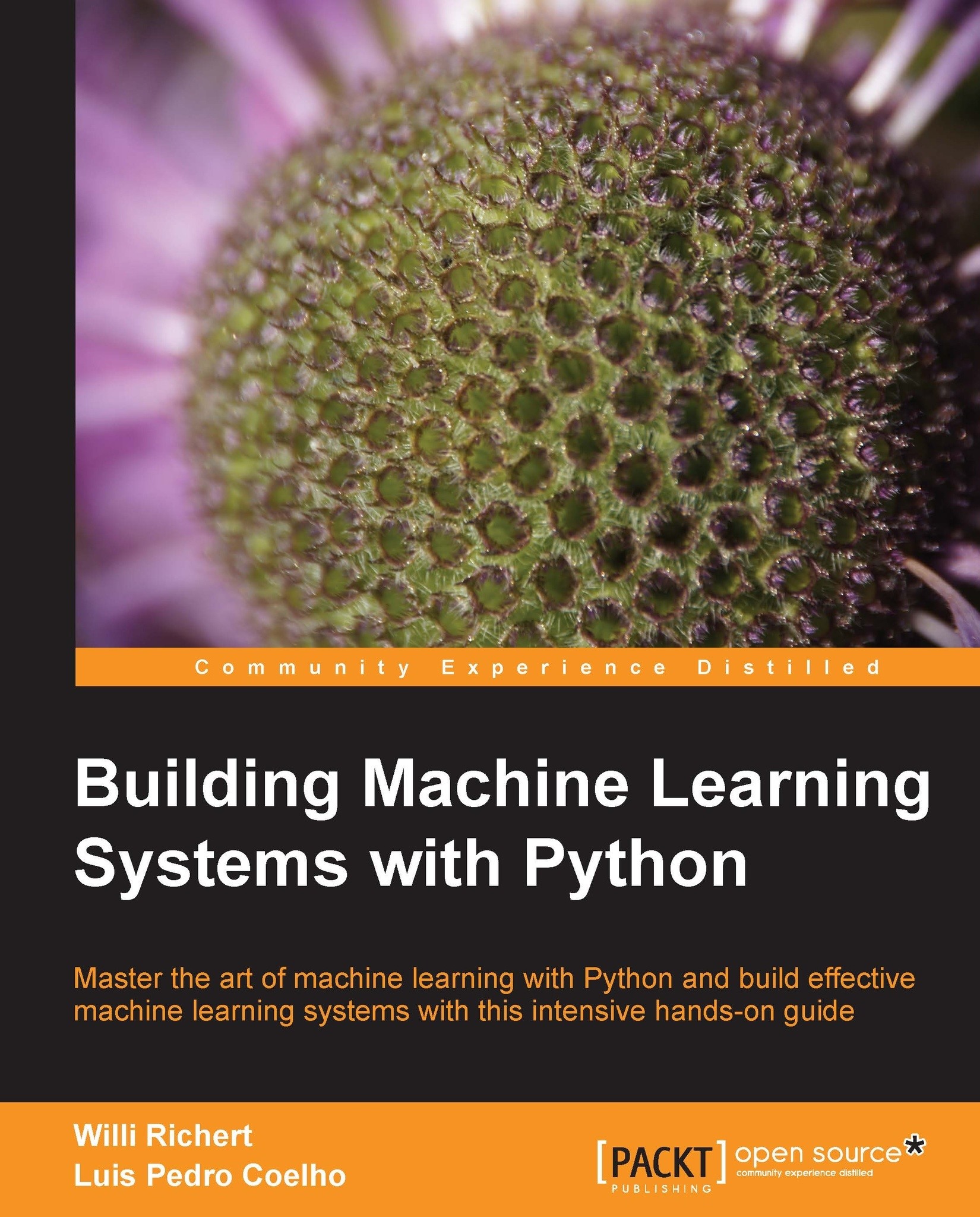
Building Machine Learning Systems with Python

Building Machine Learning Systems with Python

Expand your Python knowledge and learn all about machine-learning libraries in this user-friendly manual. ML is the next big breakthrough in technology and this book will give you the head-start you need.

€29.69 €32.99
By
Full star icon Full star icon Full star icon Half star icon Empty star icon
3.9 (38 Ratings)
Pages 290
Published in Jul 2013
Product Type eBook
Edition 1st Edition
ISBN 9781782161417
Building Machine Learning Systems with Python

Packt Subscriptions

See our plans and pricing
Modal Close icon
€11.99 billed monthly
Feature tick icon Unlimited access to Packt's library of 6,500+ practical books and videos
Feature tick icon Constantly refreshed with 50+ new titles a month
Feature tick icon Exclusive Early access to books as they're written
Feature tick icon Solve problems while you work with advanced search and reference features
Feature tick icon Offline reading on the mobile app
Feature tick icon Simple pricing, no contract
€119.99 billed annually
Feature tick icon Unlimited access to Packt's library of 6,500+ practical books and videos
Feature tick icon Constantly refreshed with 50+ new titles a month
Feature tick icon Exclusive Early access to books as they're written
Feature tick icon Solve problems while you work with advanced search and reference features
Feature tick icon Offline reading on the mobile app
Feature tick icon Choose a DRM-free eBook or Video every month to keep
Feature tick icon PLUS own as many other DRM-free eBooks or Videos as you like for just €5 each
Feature tick icon Exclusive print discounts
€169.99 billed in 18 months
Feature tick icon Unlimited access to Packt's library of 6,500+ practical books and videos
Feature tick icon Constantly refreshed with 50+ new titles a month
Feature tick icon Exclusive Early access to books as they're written
Feature tick icon Solve problems while you work with advanced search and reference features
Feature tick icon Offline reading on the mobile app
Feature tick icon Choose a DRM-free eBook or Video every month to keep
Feature tick icon PLUS own as many other DRM-free eBooks or Videos as you like for just €5 each
Feature tick icon Exclusive print discounts

What do you get with eBook?

Product feature icon Instant access to your Digital eBook purchase
Product feature icon Download this book in EPUB and PDF formats
Product feature icon Access this title in our online reader with advanced features
Product feature icon DRM FREE - Read whenever, wherever and however you want
Table of content icon View table of contents Preview book icon Preview Book

Building Machine Learning Systems with Python

Chapter 2. Learning How to Classify with Real-world Examples

Can a machine distinguish between flower species based on images? From a machine learning perspective, we approach this problem by having the machine learn how to perform this task based on examples of each species so that it can classify images where the species are not marked. This process is called classification (or supervised learning), and is a classic problem that goes back a few decades.

We will explore small datasets using a few simple algorithms that we can implement manually. The goal is to be able to understand the basic principles of classification. This will be a solid foundation to understanding later chapters as we introduce more complex methods that will, by necessity, rely on code written by others.

The Iris dataset


The Iris dataset is a classic dataset from the 1930s; it is one of the first modern examples of statistical classification.

The setting is that of Iris flowers, of which there are multiple species that can be identified by their morphology. Today, the species would be defined by their genomic signatures, but in the 1930s, DNA had not even been identified as the carrier of genetic information.

The following four attributes of each plant were measured:

  • Sepal length

  • Sepal width

  • Petal length

  • Petal width

In general, we will call any measurement from our data as features.

Additionally, for each plant, the species was recorded. The question now is: if we saw a new flower out in the field, could we make a good prediction about its species from its measurements?

This is the supervised learning or classification problem; given labeled examples, we can design a rule that will eventually be applied to other examples. This is the same setting that is used for spam classification; given the...

Building more complex classifiers


In the previous section, we used a very simple model: a threshold on one of the dimensions. Throughout this book, you will see many other types of models, and we're not even going to cover everything that is out there.

What makes up a classification model? We can break it up into three parts:

  • The structure of the model: In this, we use a threshold on a single feature.

  • The search procedure: In this, we try every possible combination of feature and threshold.

  • The loss function: Using the loss function, we decide which of the possibilities is less bad (because we can rarely talk about the perfect solution). We can use the training error or just define this point the other way around and say that we want the best accuracy. Traditionally, people want the loss function to be minimum.

We can play around with these parts to get different results. For example, we can attempt to build a threshold that achieves minimal training error, but we will only test three values...

A more complex dataset and a more complex classifier


We will now look at a slightly more complex dataset. This will motivate the introduction of a new classification algorithm and a few other ideas.

Learning about the Seeds dataset

We will now look at another agricultural dataset; it is still small, but now too big to comfortably plot exhaustively as we did with Iris. This is a dataset of the measurements of wheat seeds. Seven features are present, as follows:

  • Area (A)

  • Perimeter (P)

  • Compactness ()
  • Length of kernel

  • Width of kernel

  • Asymmetry coefficient

  • Length of kernel groove

There are three classes that correspond to three wheat varieties: Canadian, Koma, and Rosa. As before, the goal is to be able to classify the species based on these morphological measurements.

Unlike the Iris dataset, which was collected in the 1930s, this is a very recent dataset, and its features were automatically computed from digital images.

This is how image pattern recognition can be implemented: you can take images in...

Binary and multiclass classification


The first classifier we saw, the threshold classifier, was a simple binary classifier (the result is either one class or the other as a point is either above the threshold or it is not). The second classifier we used, the nearest neighbor classifier, was a naturally multiclass classifier (the output can be one of several classes).

It is often simpler to define a simple binary method than one that works on multiclass problems. However, we can reduce the multiclass problem to a series of binary decisions. This is what we did earlier in the Iris dataset in a haphazard way; we observed that it was easy to separate one of the initial classes and focused on the other two, reducing the problem to two binary decisions:

  • Is it an Iris Setosa (yes or no)?

  • If no, check whether it is an Iris Virginica (yes or no).

Of course, we want to leave this sort of reasoning to the computer. As usual, there are several solutions to this multiclass reduction.

The simplest is to use...

Summary


In a sense, this was a very theoretical chapter, as we introduced generic concepts with simple examples. We went over a few operations with a classic dataset. This, by now, is considered a very small problem. However, it has the advantage that we were able to plot it out and see what we were doing in detail. This is something that will be lost when we move on to problems with many dimensions and many thousands of examples. The intuitions we gained here will all still be valid.

Classification means generalizing from examples to build a model (that is, a rule that can automatically be applied to new, unclassified objects). It is one of the fundamental tools in machine learning, and we will see many more examples of this in forthcoming chapters.

We also learned that the training error is a misleading, over-optimistic estimate of how well the model does. We must, instead, evaluate it on testing data that was not used for training. In order to not waste too many examples in testing, a cross...

Left arrow icon Right arrow icon

Key Benefits

Master Machine Learning using a broad set of Python libraries and start building your own Python-based ML systems
Covers classification, regression, feature engineering, and much more guided by practical examples
A scenario-based tutorial to get into the right mind-set of a machine learner (data exploration) and successfully implement this in your new or existing projects

What You Will Learn

Who Is This Book For?

This book is for Python programmers who are beginners in machine learning, but want to learn Machine learning. Readers are expected to know Python and be able to install and use open-source libraries. They are not expected to know machine learning, although the book can also serve as an introduction to some Python libraries for readers who know machine learning. This book does not go into the detail of the mathematics behind the algorithms.This book primarily targets Python developers who want to learn and build machine learning in their projects, or who want to provide machine learning support to their existing projects, and see them getting implemented effectively.

Book Description

Machine learning, the field of building systems that learn from data, is exploding on the Web and elsewhere. Python is a wonderful language in which to develop machine learning applications. As a dynamic language, it allows for fast exploration and experimentation and an increasing number of machine learning libraries are developed for Python.Building Machine Learning system with Python shows you exactly how to find patterns through raw data. The book starts by brushing up on your Python ML knowledge and introducing libraries, and then moves on to more serious projects on datasets, Modelling, Recommendations, improving recommendations through examples and sailing through sound and image processing in detail. Using open-source tools and libraries, readers will learn how to apply methods to text, images, and sounds. You will also learn how to evaluate, compare, and choose machine learning techniques. Written for Python programmers, Building Machine Learning Systems with Python teaches you how to use open-source libraries to solve real problems with machine learning. The book is based on real-world examples that the user can build on. Readers will learn how to write programs that classify the quality of StackOverflow answers or whether a music file is Jazz or Metal. They will learn regression, which is demonstrated on how to recommend movies to users. Advanced topics such as topic modeling (finding a text's most important topics), basket analysis, and cloud computing are covered as well as many other interesting aspects.Building Machine Learning Systems with Python will give you the tools and understanding required to build your own systems, which are tailored to solve your problems.

Category:
Languages:
Concepts:
Tools:

Frequently bought together


Stars icon
Total 129.97
Building Machine Learning Systems with Python
€41.99
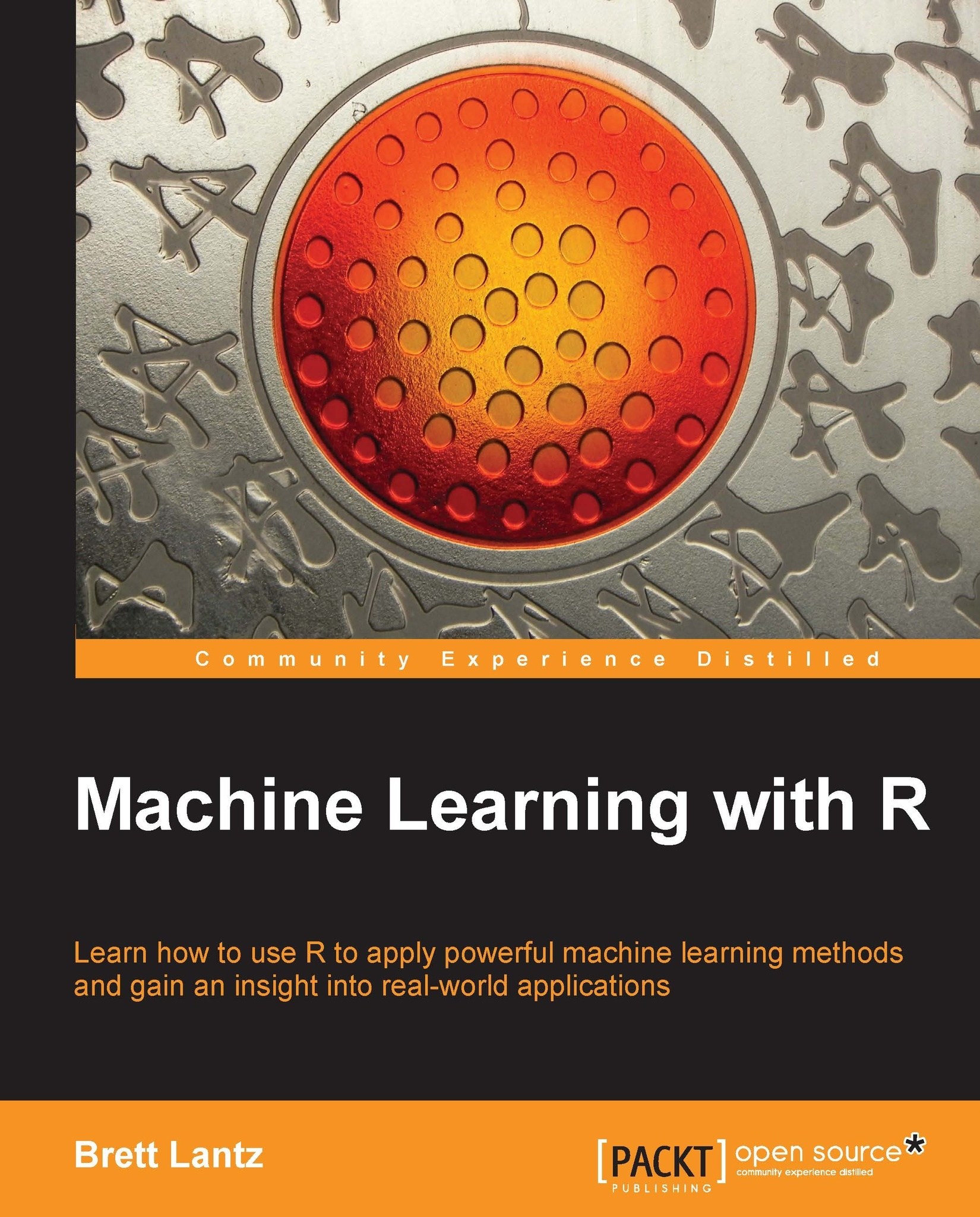
Machine Learning with R
€45.99
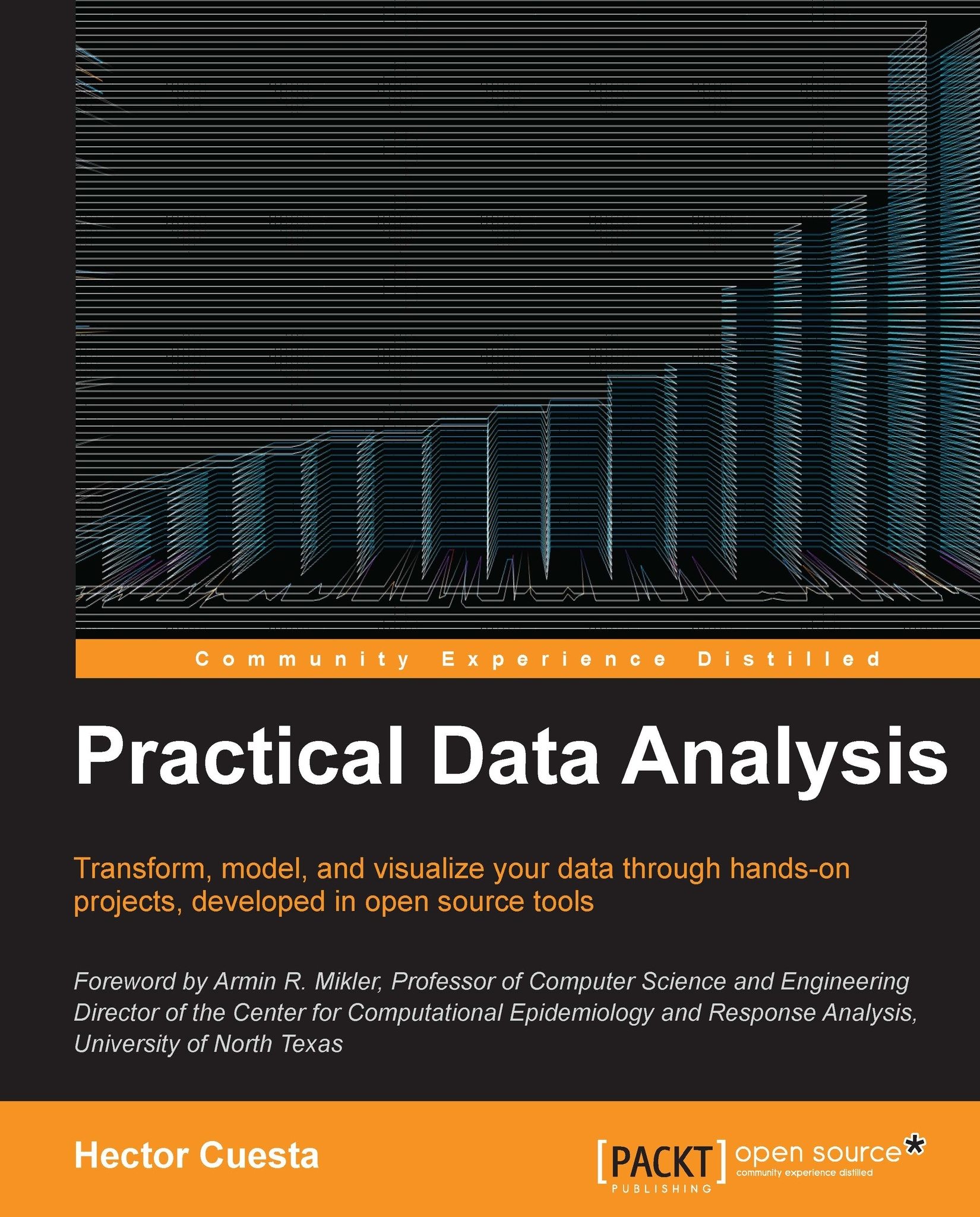
Practical Data Analysis
€41.99
Total 129.97 Stars icon

Table of Contents

(12 Chapters)
Getting Started with Python Machine Learning Chevron down icon Chevron up icon
Learning How to Classify with Real-world Examples Chevron down icon Chevron up icon
Clustering – Finding Related Posts Chevron down icon Chevron up icon
Topic Modeling Chevron down icon Chevron up icon
Classification – Detecting Poor Answers Chevron down icon Chevron up icon
Classification II – Sentiment Analysis Chevron down icon Chevron up icon
Regression – Recommendations Chevron down icon Chevron up icon
Regression – Recommendations Improved Chevron down icon Chevron up icon
Classification III – Music Genre Classification Chevron down icon Chevron up icon
Computer Vision – Pattern Recognition Chevron down icon Chevron up icon
Dimensionality Reduction Chevron down icon Chevron up icon
Big(ger) Data Chevron down icon Chevron up icon

Customer reviews

Top Reviews
Rating distribution
Full star icon Full star icon Full star icon Half star icon Empty star icon
3.9
(38 Ratings)
5 star 42.1%
4 star 28.9%
3 star 10.5%
2 star 15.8%
1 star 2.6%
Filter icon Filter
Top Reviews

Filter reviews by


Amazon Customer Jan 05, 2014
Full star icon Full star icon Full star icon Full star icon Full star icon
5
I love this book. It provides a lot of practical, clear examples and explanations that a lot of other machine learning courses just don't provide or are too slow to reach (for my ADD). I love the way the author gives enough explanation for you to grasp the concepts involved with practical machine learning systems, without going into so much detail that you just give up halfway through. 5 stars, I'm definitely looking forward to more books of this quality from Willi Richert.Daniel
Amazon Verified review Amazon
Jascha Casadio Dec 10, 2014
Full star icon Full star icon Full star icon Full star icon Full star icon
5
Quite an impressive book. I’m not sure what has amazed me most: the examples, so real and complex but still, easy to follow, or the easiness through which the authors introduce the reader to many different machine learning techniques without throwing at him scaring math formulas. Certainly both things. And not only those.As clearly stated in the preface, this book it’s not about scikit-learn. It does not expect the reader to master it. Similarly, it does not aim to teach him the library from install to Z. The book is about Python and machine learning. Many examples are, indeed, pure Python.Still, scikit-learn is used. Sometimes alone, often in combination with other widely known libraries, such as Numpy, Scipy, nltk and matplotlib. While scikit-learn and nltk are not taken from granted, whoever is holding the book on his hands is expected to have been exposed already to both the numerical libraries and to matplotlib. Methods such as norm() and rvs() are not explained and if you are not familiar with them, get ready to open both the reference and a terminal with the Python interpret.Not only do the authors rely on those must know libraries. They also show the readers some less known gem, such as gensim (a real beauty that doesn’t ship with scikit-learn).As I was saying at the beginning, the examples are very interesting. They are real world challenges, clearly explained step by step with many accompanying charts and schemas. The source code that comes with the book has some snippet that you really wanna copy somewhere safe.I have particularly enjoyed the idea behind the book itself: introduce the reader to machine learning without exposing him to the mathematical details behind it. The concepts are very well explained and the few formulas you will see won’t get you screaming terrified. I pretty much agree with this approach: we don’t need to know how an engine works to drive a car.I do absolutely recommend this little masterpiece to any Python programmer who wanna get started with machine learning. This book really get you curious about the subject. Isn’t it what all great books do?As usual, you can find more reviews on my personal blog: http://books.lostinmalloc.com. Feel free to pass by and share your thoughts!
Amazon Verified review Amazon
KJP Sep 29, 2013
Full star icon Full star icon Full star icon Full star icon Full star icon
5
It has been a great pleasure to read this book "Building Maching Learning Systems with Python".This book presents application of algorithms to real world problems from machine learning perspective. It demonstrates practical examples of solving machine learning issues with Python scripts. Analysis and reasoning follows the examples. It guides the readers with simple algorithms and extends to the more complex machine learning issues. Whether you are a software professional or non technical person, this book will serve as an introductory material to the world of machine learning. Whether you are involved in machine learning projects or not, this book will expand your horizon and may help you develop/design software solutions. I am a Python software engineer and particularly like the the machine learning tackled with Python. I therefore highly recommd this book to all who are in the IT field.
Amazon Verified review Amazon
Raz P. Dec 14, 2013
Full star icon Full star icon Full star icon Full star icon Full star icon
5
The book is an immersion in Machine Learning and Data Mining techniques using the Python language and the surrounding library echosystem. After a brief introduction in numpy, scipy, the author presents a number of data mining techniques, including linear and bayesian regressions, clustering and classifiers. On top of the classical problems, the reader learns about NLP (natural language processing) and NLP approaches in Data Mining. Other data mining techniques, such as basket analysis and Principal Component are also described, all following a real-life problem. The book ends by presenting ways to distribute the workload on multiple nodes of a clustered server and Amazon cloud. Also, a number of data mining resources, such as data sets, forums and mining competitions, are being listed; these are really helpful to expand the knowledge universe of novice readers.Through practical approach, the reader is easily introduced to a plurality of data mining techniques, while being deprived of the theoretical side of the methods. The book fits well a beginner in Data Mining, since it doesn't require mathematics or algorithms background. I advise the readers to be familiar with Python, don't commence with the book if you don't have the basics of Python language, and eventually some basics of Numpy.A must read for an application engineer involved in reporting, dashboard development and statistics; by applying one or more techniques described in the book, the application engineer will have a chance to provide added value, on top of the factual data reports. Also, a must read for students with Python knowledge considering a data mining path.
Amazon Verified review Amazon
J_Stout Nov 04, 2013
Full star icon Full star icon Full star icon Full star icon Full star icon
5
This book is a good addition to other theoretical books. Although much of the information could be gained through websites, this is a more condensed and straightforward way to learn it. This is not an all in one book and does rely on the reader to fill in the gaps with theoretical knowledge and python programming knowledge. It is well written and easy to follow.
Amazon Verified review Amazon
Get free access to Packt library with over 7500+ books and video courses for 7 days!
Start Free Trial

FAQs

How do I buy and download an eBook? Chevron down icon Chevron up icon

Where there is an eBook version of a title available, you can buy it from the book details for that title. Add either the standalone eBook or the eBook and print book bundle to your shopping cart. Your eBook will show in your cart as a product on its own. After completing checkout and payment in the normal way, you will receive your receipt on the screen containing a link to a personalised PDF download file. This link will remain active for 30 days. You can download backup copies of the file by logging in to your account at any time.

If you already have Adobe reader installed, then clicking on the link will download and open the PDF file directly. If you don't, then save the PDF file on your machine and download the Reader to view it.

Please Note: Packt eBooks are non-returnable and non-refundable.

Packt eBook and Licensing When you buy an eBook from Packt Publishing, completing your purchase means you accept the terms of our licence agreement. Please read the full text of the agreement. In it we have tried to balance the need for the ebook to be usable for you the reader with our needs to protect the rights of us as Publishers and of our authors. In summary, the agreement says:

  • You may make copies of your eBook for your own use onto any machine
  • You may not pass copies of the eBook on to anyone else
How can I make a purchase on your website? Chevron down icon Chevron up icon

If you want to purchase a video course, eBook or Bundle (Print+eBook) please follow below steps:

  1. Register on our website using your email address and the password.
  2. Search for the title by name or ISBN using the search option.
  3. Select the title you want to purchase.
  4. Choose the format you wish to purchase the title in; if you order the Print Book, you get a free eBook copy of the same title. 
  5. Proceed with the checkout process (payment to be made using Credit Card, Debit Cart, or PayPal)
Where can I access support around an eBook? Chevron down icon Chevron up icon
  • If you experience a problem with using or installing Adobe Reader, the contact Adobe directly.
  • To view the errata for the book, see www.packtpub.com/support and view the pages for the title you have.
  • To view your account details or to download a new copy of the book go to www.packtpub.com/account
  • To contact us directly if a problem is not resolved, use www.packtpub.com/contact-us
What eBook formats do Packt support? Chevron down icon Chevron up icon

Our eBooks are currently available in a variety of formats such as PDF and ePubs. In the future, this may well change with trends and development in technology, but please note that our PDFs are not Adobe eBook Reader format, which has greater restrictions on security.

You will need to use Adobe Reader v9 or later in order to read Packt's PDF eBooks.

What are the benefits of eBooks? Chevron down icon Chevron up icon
  • You can get the information you need immediately
  • You can easily take them with you on a laptop
  • You can download them an unlimited number of times
  • You can print them out
  • They are copy-paste enabled
  • They are searchable
  • There is no password protection
  • They are lower price than print
  • They save resources and space
What is an eBook? Chevron down icon Chevron up icon

Packt eBooks are a complete electronic version of the print edition, available in PDF and ePub formats. Every piece of content down to the page numbering is the same. Because we save the costs of printing and shipping the book to you, we are able to offer eBooks at a lower cost than print editions.

When you have purchased an eBook, simply login to your account and click on the link in Your Download Area. We recommend you saving the file to your hard drive before opening it.

For optimal viewing of our eBooks, we recommend you download and install the free Adobe Reader version 9.

Modal Close icon

Loading shipping options...

Unable to load shipping costs. Please try again later.

Estimated Shipping Cost

Deliver to -
Modal Close icon
Modal Close icon