Search icon CANCEL
Subscription
0
Cart icon
Your Cart (0 item)
Close icon
You have no products in your basket yet
Arrow left icon
Explore Products
Best Sellers
New Releases
Books
Videos
Audiobooks
Learning Hub
Newsletter Hub
Free Learning
Arrow right icon
timer SALE ENDS IN
0 Days
:
00 Hours
:
00 Minutes
:
00 Seconds
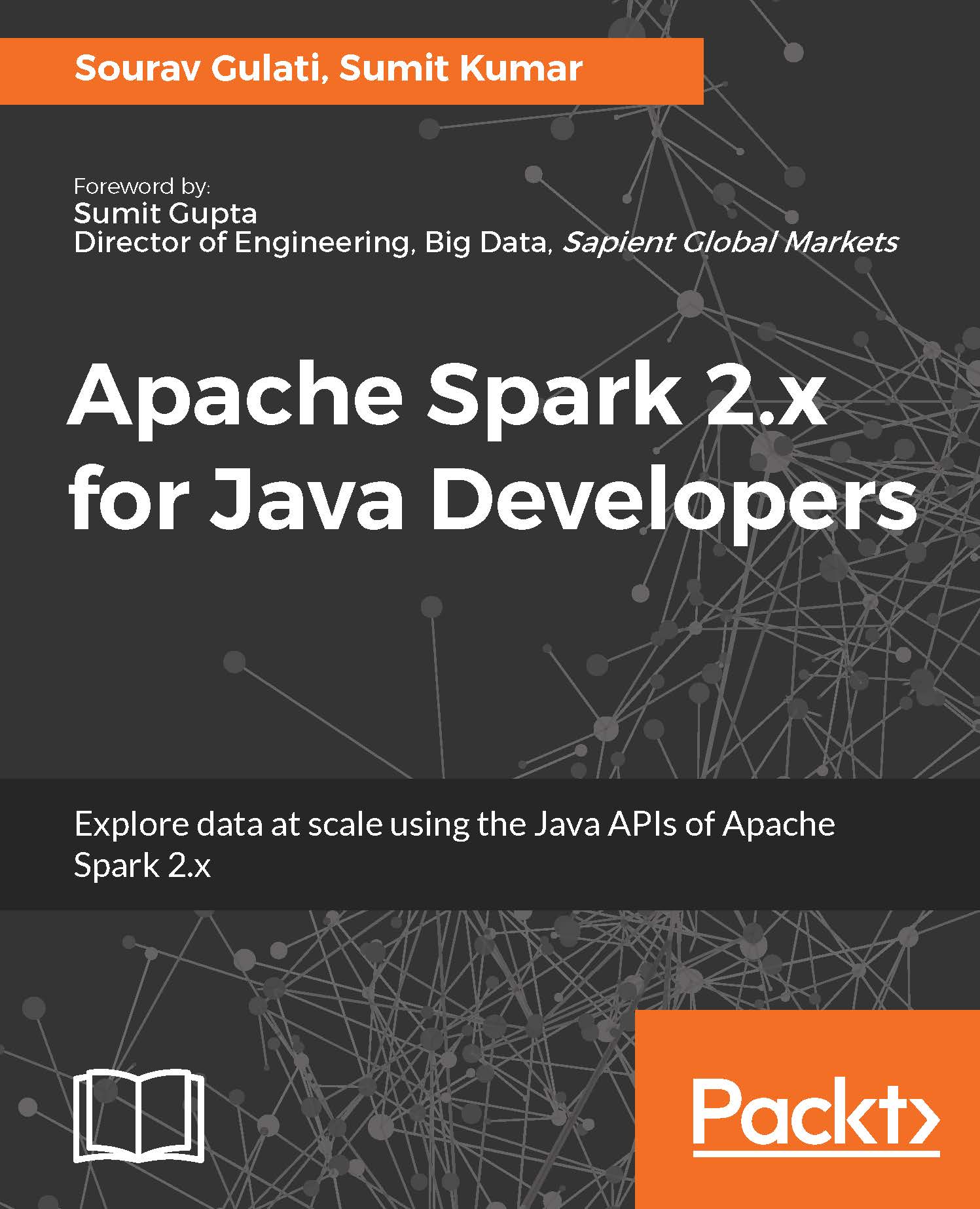
Apache Spark 2.x for Java Developers

Apache Spark 2.x for Java Developers

Explore big data at scale using Apache Spark 2.x Java APIs

Can$69.99
By Kumar & Gulati
Full star icon Full star icon Empty star icon Empty star icon Empty star icon
2 (4 Ratings)
Pages 350
Published in Jul 2017
Product Type Paperback
Edition 1st Edition
ISBN 9781787126497
Apache Spark 2.x for Java Developers

Packt Subscriptions

See our plans and pricing
Modal Close icon
$12.99 billed monthly
Feature tick icon Unlimited access to Packt's library of 6,500+ practical books and videos
Feature tick icon Constantly refreshed with 50+ new titles a month
Feature tick icon Exclusive Early access to books as they're written
Feature tick icon Solve problems while you work with advanced search and reference features
Feature tick icon Offline reading on the mobile app
Feature tick icon Simple pricing, no contract
$129.99 billed annually
Feature tick icon Unlimited access to Packt's library of 6,500+ practical books and videos
Feature tick icon Constantly refreshed with 50+ new titles a month
Feature tick icon Exclusive Early access to books as they're written
Feature tick icon Solve problems while you work with advanced search and reference features
Feature tick icon Offline reading on the mobile app
Feature tick icon Choose a DRM-free eBook or Video every month to keep
Feature tick icon PLUS own as many other DRM-free eBooks or Videos as you like for just Can$6 each
Feature tick icon Exclusive print discounts
$179.99 billed in 18 months
Feature tick icon Unlimited access to Packt's library of 6,500+ practical books and videos
Feature tick icon Constantly refreshed with 50+ new titles a month
Feature tick icon Exclusive Early access to books as they're written
Feature tick icon Solve problems while you work with advanced search and reference features
Feature tick icon Offline reading on the mobile app
Feature tick icon Choose a DRM-free eBook or Video every month to keep
Feature tick icon PLUS own as many other DRM-free eBooks or Videos as you like for just Can$6 each
Feature tick icon Exclusive print discounts

What do you get with Print?

Product feature icon Instant access to your digital copy whilst your Print order is Shipped
Product feature icon Paperback book shipped to your preferred address
Product feature icon Redeem a companion digital copy on all Print orders
Product feature icon Access this title in our online reader with advanced features
Product feature icon DRM FREE - Read whenever, wherever and however you want
Table of content icon View table of contents Preview book icon Preview Book

Apache Spark 2.x for Java Developers

Chapter 2. Revisiting Java

This chapter is added as the refresher course of Java. In this chapter, we will discuss some concepts of Java that will be useful while creating applications in Apache Spark.

This book assumes that the reader is comfortable with the basics of Java. We will discuss useful Java concepts and mainly focus on what is new in Java 8? More importantly, we will touch upon on topics such as:

  • Generics
  • Interfaces
  • Lambda expressions
  • Streams

Why use Java for Spark?


With the rise in multi-core CPUs, Java could not keep up with the change in its design to utilize that extra power available to its disposal because of the complexity surrounding concurrency and immutability. We will discuss this in detail, later. First let's understand the importance and usability of Java in the Hadoop ecosystem. As MapReduce was gaining popularity, Google introduced a framework called Flume Java that helped in pipelining multiple MapReduce jobs. Flume Java consists of immutable parallel collections capable of performing lazily evaluated optimized chained operations. That might sound eerily similar to what Apache Spark does, but then even before Apache Spark and Java Flume, there was Cascading, which built an abstraction over MapReduce to simplify the way MapReduce tasks are developed, tested, and run. All these frameworks were majorly a Java implementation to simplify MapReduce pipelines among other things.

These abstractions were simple in fact...

Generics


Generics were introduced in Java 1.5. Generics help the user to create the general purpose code that has abstract type in its definition. That abstract type can be replaced with any concrete type in the implementation.

For example, the list interface or its implementations, such as ArrayList, LinkedList and so on, are defined with generic type. Users can provide the concrete type such as Integer, Long, or String while implementing the list:

List<Integer> list1 =new ArrayList<Integer>(); 
List<String> list2 =new ArrayList<String>(); 

Here, list1 is the list of integers and list2 is the list of strings. With Java 7, the compiler can infer the type. So the preceding code can also be written as follows:

List<Integer> list1 =new ArrayList<>(); 
List<String> list2 =new ArrayList<>(); 

Another huge benefit of generic type is that it brings compile-time safety. Let's create a list without the use of generics:

List list =new ArrayList<>();...

Interfaces


Interfaces are the reference types in Java. They are used in Java to define contracts among classes. Any class that implements that interface has to adhere to the contract that the interface defines.

For example, we have an interface car as follows that consists of three abstract methods:

public interface Car { 
   void shape(); 
   void price(); 
   void color(); 
} 

Any class that implements this interface has to implement all the abstract methods of this interface unless it is an abstract class. Interfaces can only be implemented or extended by other interfaces, they cannot be instantiated.

Prior to Java 8, interfaces consisted only of abstract methods and final variables. In Java 8, interfaces may contain default and static methods as well.

Static method in an interface

The static method in an interface is similar to the static method in a class. Users cannot override them. So even if a class implements an interface, it cannot override a static method of an interface.

Like a static...

Lambda expressions


Lambda expressions are the brand new feature of Java. Lambda expressions are introduced in Java 8 and it is a step towards facilitating functional programming in Java.

Lambda expressions help you to define a method without declaring it. So, you do not need a name for the method, return-type, and so on. Lambda expressions, like anonymous inner classes, provide the way to pass behaviors to functions. Lambda, however, is a much more concise way of writing the code.

For example, the preceding example of an anonymous inner class can be converted to Lambda as follows:

public class MyFilterImpl { 
   public static void main(String[] args) { 
      File dir = new File("src/main/java"); 
      dir.list((dirname,name)->name.endsWith("java")); //Lambda Expression 
     } 
} 

Note that the signature of the Lambda expression is exactly matching the signature of the accept method in the FilenameFilter interface.

Note

One of the huge differences between Lambda and anonymous inner classes...

Lexical scoping


Lexical scoping is also referred to as Static scoping. As per lexical scoping, a variable will be accessible in the scope in which it is defined. Here, the scope of the variable is determined at compile time.

Let us consider the following example:

public class LexicalScoping { 
   int a = 1; 
   // a has class level scope. So It will be available to be accessed 
   // throughout the class 
 
   public void sumAndPrint() { 
      int b = 1; 
      int c = a + b; 
      // b and c are local variables of method. These will be accessible 
      // inside the method only 
   } 
   // b and c are no longer accessible 
} 

Variable a will be available throughout the class (let's not consider the difference of static and non-static as of now). However, variables b and c will be available inside the sumAndPrint method only.

Similarly, a variable given inside lambda expressions are accessible only to that Lambda. For example:

list.stream().map(n -> n*2 ); 

Here n is lexically scoped to...

Streams


A stream represents a collection of elements on which a chain of aggregate operations can be performed lazily. Streams have been optimized to cater to both sequential as well as parallel computation, keeping in mind the hardware capabilities of CPU cores. The Steams API was introduced in Java 8 to cater to functional programming needs of the developer. Streams are not Java based collections; however, they are capable enough to operate over collections by first converting them into streams. Some of the characteristics of streams that make them uniquely different from Java collection APIs are:

  • Streams do not store elements. It only transfer values received from sources such as I/O channels, generating functions, data structures (Collections API), and perform a set of pipelined computation on them.
  • Streams do not change the underlying data, they only process them and produce a new set of resultant data. When a distinct() or sorted() method is called on a stream, the source data does not...

Intermediate operations


Intermediate operations always return another stream and get lazily evaluated only when terminal operations are called. The feature of lazy evaluation optimizes intermediate operations when multiple operations are chained together as evaluation only takes place after terminal operation. Another scenario where lazy evaluation tends to be useful is in use cases of infinite or large streams as iteration over an entire stream may not be required or even possible, such as anyMatch, findFirst(), and so on. In these scenarios, short circuiting (discussed in the next section) takes place and the terminal operation exits the flow just after meeting the criteria rather than iterating over entire elements.
Intermediate operations can further be sub-divided into stateful and stateless operations. Stateful operations preserve the last seen value, as in methods such as sorted(), limit(), sequential(), and so on since they need them while processing the current record. For example...

Terminal operations


Terminal operations act as the trigger point in a pipelined stream operation to trigger execution. Terminal operations either return a void or a non-stream type object and once the pipelined operations have been executed on the stream, the stream becomes redundant. A Terminal operation is always required for a pipelined stream operation to be executed.
Stream operations can further be classified as short-circuiting operations. An intermediate operation is said to be short circuited when an infinite input produces a finite stream such as in the case of the limit() method. Similarly, short circuiting operations in the case of terminal operations is when an infinite input may terminate in finite time, as is the case for the methods anyMatch(), findAny(), and so on.

Streams also support parallelism , but in the case of stateful operations, since each parallel operation can have its own state, a parallel stateful operation may have to undergo multiple passes to complete the...

Summary


This chapter dealt with various concepts of Java and more particularly topics around generics and interfaces. We also discussed new features introduced in Java 8 such as Lambda expressions and streams. Introduction to the default method in Java 8 was also covered in detail.

In the next chapter, we will discuss the installation of Spark and Scala. We will also discuss Scala's REPL and the Spark UI along with exposure of Spark's REST API for working with Spark jobs, Sparks componentsm, and various configuration parameters.

Left arrow icon Right arrow icon
Download code icon Download Code

Key Benefits

Perform big data processing with Spark—without having to learn Scala!
Use the Spark Java API to implement efficient enterprise-grade applications for data processing and analytics
Go beyond mainstream data processing by adding querying capability, Machine Learning, and graph processing using Spark

What You Will Learn

Who Is This Book For?

If you are a Java developer interested in learning to use the popular Apache Spark framework, this book is the resource you need to get started. Apache Spark developers who are looking to build enterprise-grade applications in Java will also find this book very useful.

Book Description

Apache Spark is the buzzword in the big data industry right now, especially with the increasing need for real-time streaming and data processing. While Spark is built on Scala, the Spark Java API exposes all the Spark features available in the Scala version for Java developers. This book will show you how you can implement various functionalities of the Apache Spark framework in Java, without stepping out of your comfort zone. The book starts with an introduction to the Apache Spark 2.x ecosystem, followed by explaining how to install and configure Spark, and refreshes the Java concepts that will be useful to you when consuming Apache Spark's APIs. You will explore RDD and its associated common Action and Transformation Java APIs, set up a production-like clustered environment, and work with Spark SQL. Moving on, you will perform near-real-time processing with Spark streaming, Machine Learning analytics with Spark MLlib, and graph processing with GraphX, all using various Java packages. By the end of the book, you will have a solid foundation in implementing components in the Spark framework in Java to build fast, real-time applications.
Category:
Languages:
Concepts:
Tools:

Frequently bought together


Stars icon
Total Can$ 201.97
Apache Spark 2.x for Java Developers
Can$69.99
Building Data Streaming Applications with Apache Kafka
Can$61.99
Mastering Apache Spark 2.x
Can$69.99
Total Can$ 201.97 Stars icon

Table of Contents

(11 Chapters)
Introduction to Spark Chevron down icon Chevron up icon
Revisiting Java Chevron down icon Chevron up icon
Let Us Spark Chevron down icon Chevron up icon
Understanding the Spark Programming Model Chevron down icon Chevron up icon
Working with Data and Storage Chevron down icon Chevron up icon
Spark on Cluster Chevron down icon Chevron up icon
Spark Programming Model - Advanced Chevron down icon Chevron up icon
Working with Spark SQL Chevron down icon Chevron up icon
Near Real-Time Processing with Spark Streaming Chevron down icon Chevron up icon
Machine Learning Analytics with Spark MLlib Chevron down icon Chevron up icon
Learning Spark GraphX Chevron down icon Chevron up icon

Customer reviews

Rating distribution
Full star icon Full star icon Empty star icon Empty star icon Empty star icon
2
(4 Ratings)
5 star 0%
4 star 0%
3 star 25%
2 star 50%
1 star 25%
Ray Brown Apr 07, 2020
Full star icon Full star icon Full star icon Empty star icon Empty star icon
3
The index needs a lot of help. I don't know if this is a packt publisher problem. The book has a few typos, but only annoying. Spark is a huge subject and this text -- used as a notebook so you can add your own material, combined with a course on Spark can get you started in the right direction. I've not seen any great texts that cover Spark thoroughly and do not require some research on your own. Spark is a changing product that can provide significant throughput increases with Machine Learning and Extract Transform and Load (ETL) systems. Regardless of which text you purchase you will be doing research on the web to find all your answers.
Amazon Verified review Amazon
mark berman Dec 21, 2017
Full star icon Full star icon Empty star icon Empty star icon Empty star icon
2
Lots of grammatical and spelling mistakes. Detracts from quality of this book. Suggest the authors engage a professional proof reader next time.
Amazon Verified review Amazon
Amazon Customer Oct 19, 2019
Full star icon Full star icon Empty star icon Empty star icon Empty star icon
2
content not upto the mark
Amazon Verified review Amazon
phani kumar yadavilli Mar 31, 2018
Full star icon Empty star icon Empty star icon Empty star icon Empty star icon
1
Some of the chapters are staggered and they are completely unreadable. Please check the screenshots for more details.
Amazon Verified review Amazon
Get free access to Packt library with over 7500+ books and video courses for 7 days!
Start Free Trial

FAQs

What is the delivery time and cost of print book? Chevron down icon Chevron up icon

Shipping Details

USA:

'

Economy: Delivery to most addresses in the US within 10-15 business days

Premium: Trackable Delivery to most addresses in the US within 3-8 business days

UK:

Economy: Delivery to most addresses in the U.K. within 7-9 business days.
Shipments are not trackable

Premium: Trackable delivery to most addresses in the U.K. within 3-4 business days!
Add one extra business day for deliveries to Northern Ireland and Scottish Highlands and islands

EU:

Premium: Trackable delivery to most EU destinations within 4-9 business days.

Australia:

Economy: Can deliver to P. O. Boxes and private residences.
Trackable service with delivery to addresses in Australia only.
Delivery time ranges from 7-9 business days for VIC and 8-10 business days for Interstate metro
Delivery time is up to 15 business days for remote areas of WA, NT & QLD.

Premium: Delivery to addresses in Australia only
Trackable delivery to most P. O. Boxes and private residences in Australia within 4-5 days based on the distance to a destination following dispatch.

India:

Premium: Delivery to most Indian addresses within 5-6 business days

Rest of the World:

Premium: Countries in the American continent: Trackable delivery to most countries within 4-7 business days

Asia:

Premium: Delivery to most Asian addresses within 5-9 business days

Disclaimer:
All orders received before 5 PM U.K time would start printing from the next business day. So the estimated delivery times start from the next day as well. Orders received after 5 PM U.K time (in our internal systems) on a business day or anytime on the weekend will begin printing the second to next business day. For example, an order placed at 11 AM today will begin printing tomorrow, whereas an order placed at 9 PM tonight will begin printing the day after tomorrow.


Unfortunately, due to several restrictions, we are unable to ship to the following countries:

  1. Afghanistan
  2. American Samoa
  3. Belarus
  4. Brunei Darussalam
  5. Central African Republic
  6. The Democratic Republic of Congo
  7. Eritrea
  8. Guinea-bissau
  9. Iran
  10. Lebanon
  11. Libiya Arab Jamahriya
  12. Somalia
  13. Sudan
  14. Russian Federation
  15. Syrian Arab Republic
  16. Ukraine
  17. Venezuela
What is custom duty/charge? Chevron down icon Chevron up icon

Customs duty are charges levied on goods when they cross international borders. It is a tax that is imposed on imported goods. These duties are charged by special authorities and bodies created by local governments and are meant to protect local industries, economies, and businesses.

Do I have to pay customs charges for the print book order? Chevron down icon Chevron up icon

The orders shipped to the countries that are listed under EU27 will not bear custom charges. They are paid by Packt as part of the order.

List of EU27 countries: www.gov.uk/eu-eea:

A custom duty or localized taxes may be applicable on the shipment and would be charged by the recipient country outside of the EU27 which should be paid by the customer and these duties are not included in the shipping charges been charged on the order.

How do I know my custom duty charges? Chevron down icon Chevron up icon

The amount of duty payable varies greatly depending on the imported goods, the country of origin and several other factors like the total invoice amount or dimensions like weight, and other such criteria applicable in your country.

For example:

  • If you live in Mexico, and the declared value of your ordered items is over $ 50, for you to receive a package, you will have to pay additional import tax of 19% which will be $ 9.50 to the courier service.
  • Whereas if you live in Turkey, and the declared value of your ordered items is over € 22, for you to receive a package, you will have to pay additional import tax of 18% which will be € 3.96 to the courier service.
How can I cancel my order? Chevron down icon Chevron up icon

Cancellation Policy for Published Printed Books:

You can cancel any order within 1 hour of placing the order. Simply contact [email protected] with your order details or payment transaction id. If your order has already started the shipment process, we will do our best to stop it. However, if it is already on the way to you then when you receive it, you can contact us at [email protected] using the returns and refund process.

Please understand that Packt Publishing cannot provide refunds or cancel any order except for the cases described in our Return Policy (i.e. Packt Publishing agrees to replace your printed book because it arrives damaged or material defect in book), Packt Publishing will not accept returns.

What is your returns and refunds policy? Chevron down icon Chevron up icon

Return Policy:

We want you to be happy with your purchase from Packtpub.com. We will not hassle you with returning print books to us. If the print book you receive from us is incorrect, damaged, doesn't work or is unacceptably late, please contact Customer Relations Team on [email protected] with the order number and issue details as explained below:

  1. If you ordered (eBook, Video or Print Book) incorrectly or accidentally, please contact Customer Relations Team on [email protected] within one hour of placing the order and we will replace/refund you the item cost.
  2. Sadly, if your eBook or Video file is faulty or a fault occurs during the eBook or Video being made available to you, i.e. during download then you should contact Customer Relations Team within 14 days of purchase on [email protected] who will be able to resolve this issue for you.
  3. You will have a choice of replacement or refund of the problem items.(damaged, defective or incorrect)
  4. Once Customer Care Team confirms that you will be refunded, you should receive the refund within 10 to 12 working days.
  5. If you are only requesting a refund of one book from a multiple order, then we will refund you the appropriate single item.
  6. Where the items were shipped under a free shipping offer, there will be no shipping costs to refund.

On the off chance your printed book arrives damaged, with book material defect, contact our Customer Relation Team on [email protected] within 14 days of receipt of the book with appropriate evidence of damage and we will work with you to secure a replacement copy, if necessary. Please note that each printed book you order from us is individually made by Packt's professional book-printing partner which is on a print-on-demand basis.

What tax is charged? Chevron down icon Chevron up icon

Currently, no tax is charged on the purchase of any print book (subject to change based on the laws and regulations). A localized VAT fee is charged only to our European and UK customers on eBooks, Video and subscriptions that they buy. GST is charged to Indian customers for eBooks and video purchases.

What payment methods can I use? Chevron down icon Chevron up icon

You can pay with the following card types:

  1. Visa Debit
  2. Visa Credit
  3. MasterCard
  4. PayPal
What is the delivery time and cost of print books? Chevron down icon Chevron up icon

Shipping Details

USA:

'

Economy: Delivery to most addresses in the US within 10-15 business days

Premium: Trackable Delivery to most addresses in the US within 3-8 business days

UK:

Economy: Delivery to most addresses in the U.K. within 7-9 business days.
Shipments are not trackable

Premium: Trackable delivery to most addresses in the U.K. within 3-4 business days!
Add one extra business day for deliveries to Northern Ireland and Scottish Highlands and islands

EU:

Premium: Trackable delivery to most EU destinations within 4-9 business days.

Australia:

Economy: Can deliver to P. O. Boxes and private residences.
Trackable service with delivery to addresses in Australia only.
Delivery time ranges from 7-9 business days for VIC and 8-10 business days for Interstate metro
Delivery time is up to 15 business days for remote areas of WA, NT & QLD.

Premium: Delivery to addresses in Australia only
Trackable delivery to most P. O. Boxes and private residences in Australia within 4-5 days based on the distance to a destination following dispatch.

India:

Premium: Delivery to most Indian addresses within 5-6 business days

Rest of the World:

Premium: Countries in the American continent: Trackable delivery to most countries within 4-7 business days

Asia:

Premium: Delivery to most Asian addresses within 5-9 business days

Disclaimer:
All orders received before 5 PM U.K time would start printing from the next business day. So the estimated delivery times start from the next day as well. Orders received after 5 PM U.K time (in our internal systems) on a business day or anytime on the weekend will begin printing the second to next business day. For example, an order placed at 11 AM today will begin printing tomorrow, whereas an order placed at 9 PM tonight will begin printing the day after tomorrow.


Unfortunately, due to several restrictions, we are unable to ship to the following countries:

  1. Afghanistan
  2. American Samoa
  3. Belarus
  4. Brunei Darussalam
  5. Central African Republic
  6. The Democratic Republic of Congo
  7. Eritrea
  8. Guinea-bissau
  9. Iran
  10. Lebanon
  11. Libiya Arab Jamahriya
  12. Somalia
  13. Sudan
  14. Russian Federation
  15. Syrian Arab Republic
  16. Ukraine
  17. Venezuela
Modal Close icon

Loading shipping options...

Unable to load shipping costs. Please try again later.

Estimated Shipping Cost

Deliver to -
Modal Close icon
Modal Close icon